
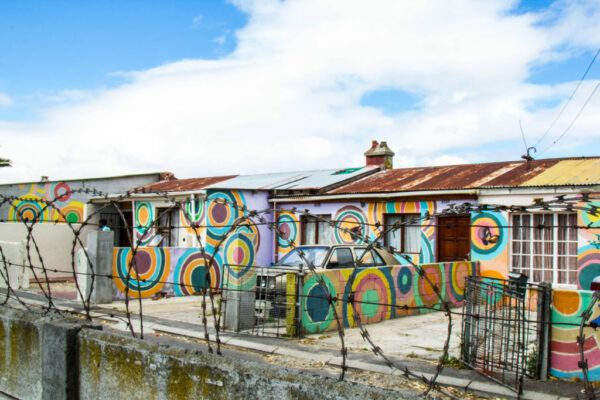
- Province: Western Cape
- Coordinates: 33.9447° S, 18.5323° E
- Area 3.09 km2
- Municipality: City Of Cape Town
Langa is situated in the Cape Town metropolitan area. The suburb lies along the N2, approximately 15 km east of Cape Town’s city centre. It is located near neighbouring areas such as Athlone, Bonteheuwel, and Pinelands.
History of Langa
Langa is one of Cape Town’s oldest townships and has a history that reaches back to the early development of African urban settlements in the city. The area was associated with the name Langalibalele before the township itself was established. Langalibalele was a Hlubi chief who resisted the Natal government and was imprisoned on Robben Island in 1873. He was later moved to the Cape, where he lived under restrictions on the farm Uitvlugt, near present-day Pinelands.
The name Langa comes from Langalibalele, although langa also means “sun” in isiXhosa. The name therefore has an interesting double meaning, but its historical connection is with the chief rather than with the appearance of the landscape. The area became known as Langalibalele’s Location before the establishment of the modern township.
Langa developed in stages. The settlement was formally established in 1927 following the implementation of the 1923 Urban Areas Act and the relocation of residents from Ndabeni, Cape Town’s first officially established African township. The new township was planned by the authorities and was intended to provide housing for African residents while allowing the government to control movement into and within the city.
The early houses and facilities were basic, and the township developed under a system of strict regulation. Men who came to Cape Town for work were accommodated separately from families in some parts of the settlement, reflecting the migrant labour system of the period. The authorities also controlled who was permitted to live in the township.
One of Langa’s more unusual early features was the struggle over sorghum beer. Brewing umqombothi had traditionally been an important source of income for African women, but municipal authorities sought to control the production and sale of beer through municipal beer halls. Residents strongly resisted this system. Women in particular became involved in opposition to the beer halls, since the regulations threatened an established source of income as well as a longstanding social practice. Protests continued over many years, and in 1947 Langa activist Winifred Seqwana was arrested during a protest against the introduction of beer halls.
Langa became an important centre of political and community activity during the apartheid era. Residents participated in campaigns against pass laws and other discriminatory legislation, and the township was one of the Cape Town centres of resistance during the 1960 anti-pass campaign. Churches, civic organisations, sporting clubs and community groups also became important parts of everyday life and helped establish the strong community networks for which Langa became known.
The township developed a lively cultural life alongside its political history. Music, particularly jazz, became an important part of Langa’s identity, and the area produced and attracted many musicians and performers. Informal performances, social clubs and shebeens provided places where music could be heard and local talent developed. Langa subsequently became closely associated with the Cape’s distinctive jazz tradition.
The arts remain an important part of the community. The Guga S’Thebe Arts and Culture Centre was established as a community arts facility and has become one of Langa’s best-known landmarks. Its theatre is particularly unusual. Completed in 2015, the building incorporates 11 reused shipping containers together with recycled fruit-crate timber and other locally available materials. Architects and architecture students from South Africa and overseas worked with members of the Langa community on the project. The result is a theatre made partly from materials that would otherwise have been discarded.
Langa’s history is therefore not simply the story of a township created by government planning. It is also the story of the people who built their lives within it, established businesses and community organisations, made music, played sport and repeatedly organised around issues that affected their daily lives.
Today Langa is a well-established community with homes, schools, businesses, churches, sporting facilities and a growing cultural precinct. The older parts of the township remain alongside later development, providing a visible connection with the early history of Cape Town’s African urban communities.
Read more about the story of the Cape Flats
The postcode in Langa is 7455
Transport
Langa is served by Metrorail, MyCiTi Bus, Golden Arrow Bus Services, and minibus taxis. See linked pages for details. Other options for getting around the Western Cape.
Resources
Practical information for the Western Cape, Regulations, permits and helpful tips. See the Colourdots coastal and nature use guide
Things to see and do in Langa
- King Langalibalele Drive is one of the busiest streets in the suburb. The street was renamed in 2014 to honour amaHlubi chief Langalibalele, who was imprisoned on Robben Island in 1873. It is a fascinating stretch of road which is home to some of the country’s most famous musicians and sports stars
- Video
- The Langa Memorial Collective, led by Bongani Mbangeni, Mark O’Donovan, Malcolm Campbell, and Shirley Gunn, was designed for the Sharpeville riots.

Useful Numbers
Residents and visitors can find important local contact numbers below, including police, medical services, utilities, and community facilities
-
Emergency Services
- Police: 021-6958000, 021-6958006
- Fire: Epping021 534 1387
- Ambulance: 10177
-
Medical
- Clinic;021 694 1740
- Community Health Centre· Pharmacy-021 694 1740
-
Municipal & Utilities
- Water and electricity: 0860 103 089
-
Transport & Roads
- Traffic department: Gugulethu 021-6958000, 021-6958006
- Road Emergencies / SANRAL: 0800 204 204
- Childline-116
-
Community & Safety
- 24 hour Poisons Information Helpline of the Western Cape: 0861 555 777.
- SPCA: Cape Of Good Hope- 021 700 4140
- NSRI 087 094 9774
-
Local Contacts and Community Resources in Langa
- Museum; Heritage / Dompas Museum-021 694 8320
- Tourism;021 695 5098
- Post office;021 694 6281
- Multi-purpose Sports centre: 021 694 7700 Bunga Ave
- Indoor Sports centre:021 444 5802
- Community hall: 021 444 5802
- Monwabisi Recreation Centre:021 444 5802
-
Schools in Langa
- High School-021 694 1874
- Thembani Primary School-021 694 1829
- Leap School -021 012 5067-081 347 4430
- Ikamvalethu Secondary School-021 694 9933
- Siyabulela Primary School-021 694 2718
- Zimasa Primary School-021 694 2775
- Mokone Primary School-021 694 0201
- Moshesh Primary School-021 694 1834
- Isilimela Secondary School-081 347 4430
- Kulani Secondary School-021 694 3301
- Zimasa Primary School-061 479 6252
- Lagunya Finishing School-021 694 1801
- Saint Louis (RC) Primary School.-021 694 2157
- Find a comprehensive list of Cape Town Emergency numbers HERE
- The City of Cape Town Public Emergency Communication Centre is available 24/7 For all life or property-threatening emergencies. Call 021 480 7700 from any phone or 107 from a landline or report online at https://bit.ly/3o4Ji3K
Other Cape Flats towns and suburbs include: Athlone; Atlantis; Belhar; Blue Downs; Bonteheuwel Crawford; Crossroads; Delft; Eerste Rivier; Epping; Grassy park; Hanover Park; Khayalitsha; Kuils River; Lansdowne; Lotus river; Macassar; Mannenberg; Mitchells Plain; Nyanga; Ottery; Philippi and Thornton
- Colourdots is an independent regional information resource for the Western Cape.
Learn more about the project HERE