
- Province: Western Cape
- Coordinates 33°57′56″S “18°38′40″E
- Area 11.08 km2
- Municipality City of Cape Town
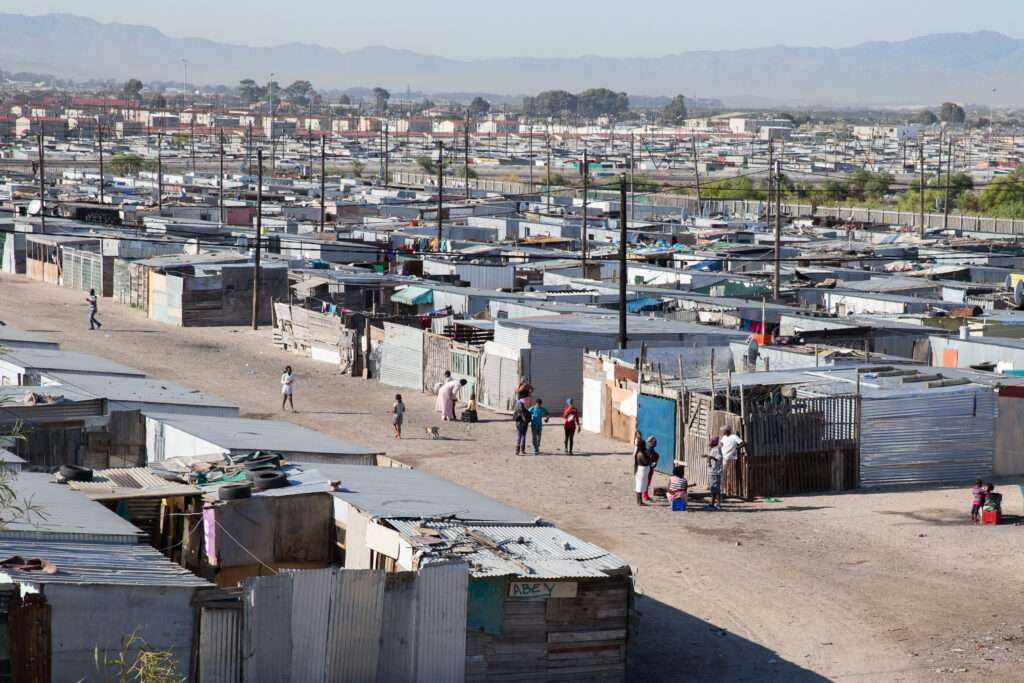
Delft is a suburb on the Cape Flats in Cape Town, located between Philippi and Blue Downs. It forms part of the City of Cape Town metropolitan area and is primarily residential, with schools, community facilities and small local business areas. The suburb is connected to the N2 via regional roads, providing access to central Cape Town and surrounding areas.
The Cape Flats is a flat, low-lying coastal plain made up of ancient dunes, sandy soils and scattered wetlands. At around 46–50 metres above sea level, the area is suitable for large-scale housing developments but is prone to poor drainage and occasional flooding.
Jump to: History of Delft |Useful Numbers in Delft
History of Delft
Delft is a relatively new township on the Cape Flats. It was established in 1989 on a farm situated next to Cape Town International Airport and was developed during a period when Cape Town was experiencing a growing demand for affordable housing. The township expanded during the final years of apartheid and continued to grow after 1994.
The name Delft has a distinctly Dutch connection. Several sections of the township were given the names of Dutch towns and places, including Voorbrug, Leiden, Eindhoven, Roosendal and The Hague. Delft is also the name of the historic Dutch city famous for its blue-and-white pottery, although the exact reason for choosing Delft as the name of the Cape Town township is not clear. The City of Cape Town confirms that the land on which Delft was established was a farm, but there is no reliable evidence that the farm itself was called Delft.
Delft developed in a number of sections rather than as one single neighbourhood. These include Delft South, also known as Suburban, Voorbrug, Leiden or Delft Central, Eindhoven, Roosendal, The Hague and the later Symphony section. Some parts were still known mainly by numbers many years after the township was established. In 2016, the City of Cape Town began a process of giving several of these numbered areas names.
The development of Delft was closely connected with Cape Town’s housing history. The apartheid-era system of racial segregation and forced removals had already displaced tens of thousands of people to the Cape Flats, including residents of District Six. Delft was developed as part of the expanding network of Cape Flats residential areas, providing housing for people affected by the city’s housing shortage as well as for families moving from overcrowded areas and informal settlements.
One of the most significant chapters in Delft’s recent history came with the N2 Gateway housing project. In December 2007, residents occupied unfinished government-built houses in the new Symphony section. The occupation began on 19 December and was followed by a prolonged dispute over housing allocation and eviction. Court proceedings eventually resulted in the occupants being removed in February 2008. Some of those displaced subsequently lived along Symphony Way, becoming known as the Symphony Way pavement dwellers.
Delft is also part of the wider transport planning for Cape Town’s south-eastern suburbs. Symphony Way forms part of a planned transport and urban development corridor, and a proposed Blue Downs rail link between Khayelitsha and Bellville has long been associated with this corridor.
The township has developed its own local economy alongside the formal shops and businesses. Spaza and house shops provide everyday goods in small quantities, while takeaways, street vendors and informal food businesses serve the surrounding community. These small businesses form an important part of daily life in Delft.
Today Delft is a large residential community made up of several distinct sections, with government housing, private homes, schools, businesses and community facilities. Its mixture of Dutch place names and relatively recent Cape Flats history gives it a character quite different from the older suburbs of Cape Town.
Read more about the story of the Cape Flats
The postal code for Delft is 7100
Transport
Delft is served by Golden Arrow Bus Services and minibus taxis. See linked pages for details. Other options for getting around the Western Cape.
local WEATHER TODAY
Browse businesses and places to visit in Delft
Things to see and do in Delft
- Bagzane Street Park Outdoor Gym
- Delft Shopping Mall offers 33 tenants, including big brand “Anchor Tenants
Resources
For permits, fishing rules, shell collecting regulations and other practical outdoor information, see the Colourdots coastal and nature use guide

Useful Numbers in Delft
Residents and visitors can find important local contact numbers below, including police, medical services, utilities, and community facilities
-
-
Emergency Services
- Police: 021 954 9000
- Fire: Belhar Fire Station-021 480 7700
- Ambulance: 10177
-
Medical
- Closest hospital; Day Hospital-021 954 2237
- Community Health Centre-021 954 2282
- Clinic-021 444 8976
- Pharmacy;021 955 0096
-
Municipal & Utilities
- Municipality – 0860 103 089
- Water: 0860 103 089
- Electricity:0860 103 089
-
Transport & Roads
- Traffic department: Philippi-East Traffic Department-021 370 1520
- Road Emergencies / SANRAL: 0800 204 204
-
Community & Safety
- NSRI 087 094 9774
- 24-hour Poisons Information Helpline of the Western Cape: 0861 555 777.
- SPCA: Cape Of Good Hope-021 700 4140
-
Local Contacts and Community Resources
- Post office;021 954 5063
- Library: 021 400 3678
- Civic centre:021 444 0516
- Community centre:021 444 0516
- Mandela Peace Park Recreation centre: 021 444 0516
- The Hague Sport and Recreation Centre: 021 444 0516
-
Schools in Delft
- Delft South Primary School-021 955 3397
- Delft Primary School-021 954 1127
- Technical High School-021 956 0058
- Sunray Primary School-021 955 2651
- Masonwabe Primary School-021 955 3026
- Leiden Primary School-021 954 2691
- Simunye High School-079 182 0270
- Kairos Primary School-021 954 2749
- Vergenoegd Primary School-021 954 1244
- Secondary School-076 413 1965
- Leiden Secondary School- 021 954 2688
- Simunye Secondary School-021 955 2057
- Eindhoven Primer Skool-021 955 1171
- Rosendal High-0219562006
-
Other Cape Flats towns and suburbs include: Athlone; Atlantis; Belhar; Blue Downs; Crawford; Eerste Rivier; Epping; Grassy park; Hanover Park; Khayalitsha; Kuils River; Lansdowne; Lotus river; Macassar; Mannenberg; Mitchells Plain; Nyanga; Ottery; Philippi and Thornton
- Colourdots is an independent regional information resource for the Western Cape.
Learn more about the project HERE