
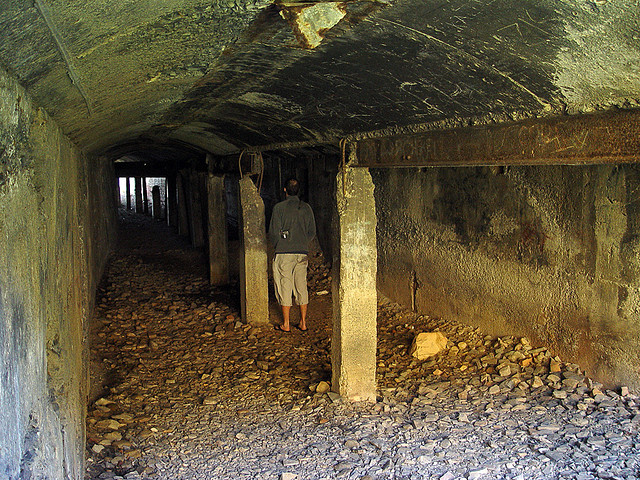
This page provides an overview of mining activity in the Western Cape, including historical mining attempts, industrial minerals, and modern extraction along the West Coast.”
Mining in the Western Cape has never been significant, but there have been some spectacular failures and a few confidence tricks, some that have left dreams sadly ruined. There were small gold rushes near Knysna, Prince Albert and Lion’s Head, and some failed silver mining attempts around the Peninsula. Manganese was mined at Hout Bay, tin near Kuils River and Vredehoek, and materials such as kaolin, limestone, salt and silica sand supported early local industries. Today, mining continues mainly on the West Coast and in parts of the Karoo.
On this page, jump to:
- Manganese Mining in the Western Cape
- Tin Mining
- Silver Mining in the Western Cape
- Gold Mining in the Western Cape
- Salt Mining
- Clays and Kaolin
- Limestone and Calcrete
- Glass-Making Sand
- Mining in the Western Cape Today.
For centuries, people searched the Western Cape for hidden wealth beneath its mountains, forests and coastline. Unlike the great mining regions of South Africa, however, the province never produced vast fortunes or major mineral fields. Instead, its mining history is filled with short-lived gold rushes, abandoned tunnels, speculative ventures, forgotten industries and ambitious schemes that often collapsed as quickly as they began. From manganese workings above Chapman’s Peak and silver mining scams on Simonsberg to the lost goldfields of Millwood and modern mineral sand operations on the West Coast, these stories reveal a fascinating and often overlooked side of the Western Cape’s history
Manganese Mining in the Western Cape
Hout Bay Manganese Mine
This was probably the most successful attempt at mining in the Western Cape. There are several deposits of manganese on the Peninsula. They are not large, and the phosphorus content is high. Deposits were worked in Constantiaberg in 1880. There were also deposits found on the slopes above where Chapman’s Peak is today. A Hout Bay farmer, J Trautman, sold 22 morgen of the mountainside for R 2 per morgen. A couple of months later, when manganese was discovered on the slope, the land changed hands at R 240 per morgen.
Manganese was mined here for several years, the labour mostly being done by imported Indian workers. Six levels of open-face working are still visible. Some of the passages go 60 metres into the mountainside. Hout Bay Manganese Ltd was formed in 1909 by A J Parker.
There were no tarred roads, and the ore was transported by sea. A 750-metre chute was constructed at 45 degrees from corrugated iron to move the ore from where it was mined onto the boats. Ore tumbled down the chute. A crane hoisted the ore into cocopans, which were railed along a specially built jetty and then onto a barge.
The ore was sent to Britain and Belgium. Unfortunately, while the idea of the chute was good, the ore overheated as it tumbled downwards, and it often got stuck. Clearing it involved taking the chute apart, and the ore had to be loosened with dynamite blasting.
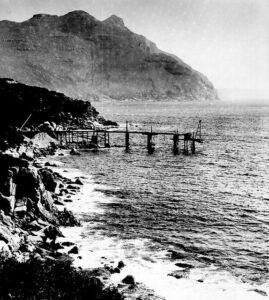
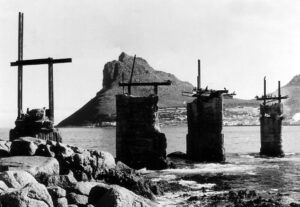
Remains of the manganese mining jetty in Hout Bay
The mining methods, however, were slow and inefficient. In 1910, some 5000 tons of ore were produced, but in 1911, just 130 tons. The mine closed down, and all that can be seen today are the concrete pillars of the jetty jutting out into Chapman’s Bay. The old adits form an interesting sight for mountain climbers. to see. The Hout Bay Museum has photographs showing the mining operations.
The Du Toitskloof Manganese Mine
Probably the Western Cape’s largest yet mostly forgotten mining venture. However, like so many other mines around the world, it raised high hopes of fortune hunters but absorbed a substantial amount of capital. The manganese mine sat high in the Du Toitskloof Mountains. The deposit was discovered during the 1870s on the steep slopes between Miaspoort and the old Kleigat section of the pass above the point where the Molenaars River joins Du Toit’s Kloof Stream, i.e., near the old original road tunnel. Contemporary reports described a substantial body of high-grade manganese ore, and there was considerable optimism that the mine could become an important industry for the region.
The biggest challenge was not the quality of the ore, but its location. The mine lay deep in rugged mountain terrain with no practical transport route to carry large quantities of ore to market. To overcome this obstacle, an ambitious proposal was made to construct an aerial cableway that would carry the ore from the mine to the top of the mountain before transporting it down towards Wellington. Despite the ingenuity of the idea, the project proved difficult and expensive to implement. Unfortunately, no photographic record of the cableway appears to have survived,
Without a reliable and economical transport solution, the mine struggled to operate profitably. The cableway scheme never fulfilled its promise, and the mine eventually closed. Today, little remains to remind visitors of the venture, and the story of the Du Toitskloof manganese mine has largely faded from public memory.
Although short-lived, the mine forms an interesting chapter in the history of the Du Toitskloof area. It highlighted the need for better access through the mountains and became part of the broader story of engineering and transport improvements that eventually led to the construction of the modern Du Toitskloof Pass in the 1940s.
Tin Mining
Kuils River
Tin was mined on the farm Annexe Langverwacht 245 in the early 1900s. It is now called Zewenwacht. The majority of the production was from alluvial deposits. It produced over 700 tons of cassiterite (SnO2). Working ceased in 1956
Vredehoek
The Vredehoek tin mine was established in 1911 by the Vredehoek Tin Company. By January 1912, reports confirmed that tin was being extracted from a shaft approximately 180 feet deep, with cocopan tracks laid to support the transport of ore. Mining operations continued into the 1930s, but total production remained very small, with only about four tons of ore concentrate recovered. Remnants of the operation are still visible today, including stone ore-crushing platforms and concrete washing troughs beside a stream, while a second shaft and adit remain concealed behind a stone wall.
Silver Mining in the Western Cape
The Zilvermyn on the Steenberg (Silvermine)
The Dutch, looking for deposits of silver, mistook other minerals for it. Before there were more sophisticated ways to identify the metal, identification relied on the unaided eye, and the only known microscope and “burning glass” belonged to Governor Simon van der Stel. The best known of the “silver mines” is the Zilvermyn in the Steenberg district. This is one of three mines; the others were on either side of the Silvermine River in the valley below.
An entry in “The Company’s Diary states that on 15 November 1687, Simon van der Stel. He was on his way to the bay that was later named Simon’s Town after him. He found three company employees who were stationed at the mine, walking on the beach in possession of two muskets. They claimed to be searching for runaway slaves. It is more likely they were enjoying a hunting trip.
Months later, an inspection of the mines found them ruined. A large quantity of ore was found. It was thought to be copper ore, but it turned out to be coarse hematite mixed with copper dust. The shaft had collapsed. In 1686, the company’s Chief Miner, Frederick von Werlinckhoff, claimed to have found silver on Van der Stel’s farm Witteboomen.
A sixteen-fathom shaft was dug in what is now Cecelia Forest. After a dispute, the miners requested a transfer. A suspicious Van Der Stel asked another Chief Miner, Gabriel Moller, to investigate. This revealed that there was no silver. The mines were never offered up for sale and remained the property of the Dutch East India Company. Silvermine shafts remain and can be seen in the forest
The Pniel Hoax
On the slopes of Simonsberg above Pniel lie the remains of 18th-century mine workings, including shafts, tunnels, and an industrial complex with furnaces, a smithy, ore processing areas, and accommodation for workers and animals. The site dates to the 1740s and is linked to the so-called Pniel Silvermine scam, when investors were misled into funding a silver mining venture that never produced any ore. Despite several years of activity, no silver was found. Earlier shafts had already been dug in 1687, and the area later saw defensive positions in 1805 and farm grants soon after. Today, the partially excavated ruins form a recognised heritage site and local tourism attraction, with guided access to the remaining tunnels and structures.
Gold Mining in the Western Cape
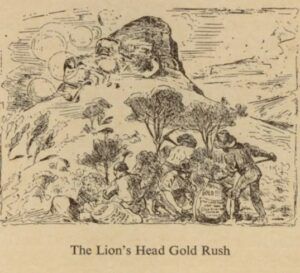
Gold Rush
For a long time, people believed that there were gold deposits at the Cape. Unsurprisingly, as various indigenous societies had been trading in the precious metal about 1000 years ago
Some very small deposits were found; however, they were not economical to exploit. A small bit of gold was found on Lion’s head. In 1887, the Cape Argus of 23rd November printed a Supplement about the mine, and a mini gold rush began. The Lion’s Head Gold Mining Company was launched, and shares were offered. A 45m shaft was sunk, and from a ton of quartz containing pyrite, only two ounces of gold were extracted.
A further survey concluded that there was a good chance of finding more. 7 ½ tons of ore were dispatched overseas. However, only about 4 kilos were tested and also not by the required methods, and no gold was found in the ore. The project was disbanded, and the city bought the property. The shaft, however, remained open until 1954, when a firefighter almost fell into it while battling a mountain fire.
The discovery of gold near Knysna in 1876 sparked one of South Africa’s lesser-known gold rushes deep in the forests around Millwood and Jubilee Creek. Prospectors from across the world arrived to search the rugged gullies and riverbeds, and by the late 1880s, Millwood had developed into a busy mining settlement with hotels, shops, newspapers and hundreds of residents. Heavy machinery was brought into the forests, and hopes were high that the area might rival other goldfields in the country.
The excitement was short-lived, however. Although some gold was found, the deposits proved difficult and limited, and by 1888, the diggings were already declining as prospectors drifted away towards the richer Witwatersrand goldfields. The once-bustling settlement eventually fell silent, leaving behind abandoned workings, old mining equipment and one of the most fascinating forgotten gold rush stories in the Western Cape. Remains of the village can still be seen today. Visit the Knysna museum complex.
Gold rush in the Karoo
Table Mountain hoax
A quirky story from 1849 happened when a wily shopkeeper displayed a nugget of gold that he claimed came from Table Mountain in his shop window. A gold rush followed, with hopeful prospectors climbing Platteklip Gorge. When they arrived, they found the shopkeeper there with cool drinks and food for sale. This was repeated for several days. No gold was found on Table Mountain. The nugget originally came from Australia.
Salt Mining
Before fridges were common kitchen appliances, much food was preserved using salt. Salt was a valuable commodity, and even Roman soldiers were given a salt ration with their pay called a “salarium”, and our modern word “salary” comes from this.
The Dutch settlers first mined salt at Rietvlei and Paarden Eiland; however, a better quality of salt was found at Noordhoek Salt Pan, which was first worked in about 1817. Today, the salt pan is overgrown with vegetation, but it can still be seen. It was regularly replenished with fresh brine during winter high tides. The pan proved to be uneconomical when salt from other places was much cheaper and more plentiful.
By 1930, the pan was no longer used as a salt mine, so the vegetation was cleared and the space was converted into Cape Town’s very first motor racing circuit. In 1935, when the sport moved to Pollsmoor.
There are abundant salt pans on the West Coast near Veldrif
Clays and Kaolin
Shale clays formed in Malmesbury shales are suitable for brickmaking. Over the years, brickfields were established where these deposits were plentiful.
The first was in 1654, next to The Company’s Garden, where a “tile baker” named Wouter Mostert formed bricks for use in the early buildings of the colony. Since then, there have been many deposits found, especially in the area around Devil’s Peak and Signal Hill.
A company called Caporn and Co. was formed in Tamboerskloof in 1898. A patent Bennett and Sayers plant, which was powered by a Clench engine and boilers by Arnold of Lancashire, could make 20,000 bricks a day. There was a 45-metre-high smokestack for the kiln. Clay was transported by a pulley system.
In the 1920s, however, Tamboerskloof was zoned for residential development. In 1835, Hare’s Lime Kiln and Brickfields opened in Mowbray. When these brickworks were demolished, a magnificent, old Dutch kiln was destroyed to make way for the Forest Hill apartments on the Main Road. There is a brickwork mural of the old kiln that can be seen on the Main Road façade of the building.
Another type of clay is kaolin, or china clay, which is used for making ceramics. It is formed by the alteration of feldspars in granite. It has been actively mined in the Fish Hoek Valley since 1953. The main client is Continental China.
Open-pit/strip mining was done by Serina Kaolin (Pty) Ltd at Brakkloof, Plettenberg Bay. Quartz, mica, and other unwanted minerals were removed from the clay. This was filtered, purified, and then compressed into cakes for easy handling. A new mine was also later opened on the northern side of the Noordhoek valley, on the slopes of Chapman’s Peak.
Limestone and Calcrete
The first lime for cement making was manufactured in Kalk Bay. (Lime Bay) It was obtained by burning seashells. There were big deposits of calcrete on the False Bay coast, which is a low-grade limestone mixed with sand. The cliffs at Swartklip and Booi se Skerm, where there are also shallow caves, are composed of this. These cliffs are also in the Cape of Good Hope Nature Reserve. In 1890, John McKellar built a lime kiln near Cape Point where he burnt calcrete. The kiln was designed so that wagons could drive up and have the product tipped into them. Remains of the kiln can be seen today.
The company was called the “Cape Point Lime and Cement Works”. The kiln was restored in 1990 and can be seen in the Reserve. The National Portland Cement Company used calcrete taken from the Cape Flats between 1939 and 1980 on a much larger scale. There is also a limestone quarry on Robben Island. It was formerly worked by prisoners on the island.
Glass-Making Sand
There are several deposits of high silica-content glass-making sand on the Peninsula. The first place where glass was made was at Papendorp (Woodstock). The South African Glass Company started making glass in 1879. The factory was next to the railway line in Observatory. There was a showroom on the corner of Burg and Shortmarket Streets on Greenmarket Square. Skilled staff for the factory were brought from England. 500 shares at £10 each were sold. However, the factory was beset with problems, and it was closed in 1882.
The next attempt took place in Glencairn in 1902 by the Cape Glass Company. They claimed they were able to produce 8 ½ million bottles a year in either dark green or clear aqua-coloured glass,
Glencairn, at the time, was remote and windswept. The workers were not happy there, and many returned to Britain. The factory was closed in 1905.
The third attempt happened in Phillipi in 1925 by Consolidated Glass Works Ltd. 2 million tons of sand have been extracted over the years. Consol’s factory at Bellville dates from 1956.
Mining in the Western Cape Today
Mining heavy metals on the West Coast
Mining has formed part of the West Coast economy for more than a century, particularly through the extraction of heavy mineral sands containing zircon, ilmenite and rutile. These minerals are found within coastal sand deposits in areas around Saldanha and Matzikama. They are mined for use in industries including ceramics, architecture, manufacturing, aircraft construction and industrial processing. Rutile is especially valuable because of its high titanium content, while zircon is widely used in ceramics and zirconium products. Minerals extracted along the West Coast are processed and transported through Saldanha before being exported to international markets.
Communities in the area remain divided over the industry’s long-term impact. While mining provides employment and investment, concerns have also been raised about environmental damage, limited rehabilitation of mined areas and the temporary nature of many jobs. Some local fishing communities have further linked offshore exploration and mining activity to declining catches of snoek and crayfish in traditional fishing grounds along the coast.
Sand mines dot the Western Cape landscape, extracting this vital material that forms the backbone of many projects. Sand is an indispensable ingredient in modern society
Uranium
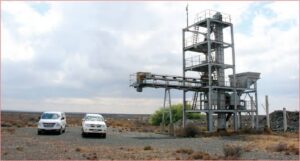
Mining and mineral exploration continue in parts of the Karoo around Beaufort West, where large uranium deposits have attracted renewed interest from mining companies in recent decades. Proposed operations include both open-cast and underground mining across extensive areas of the Central Karoo, with uranium ore planned for processing near Beaufort West before export. Supporters point to possible investment and employment opportunities. At the same time, concerns raised by residents, farmers and environmental groups include water usage, dust, rehabilitation of old mine sites and the long-term environmental impact on the region’s fragile landscapes and underground water resources. The Beaufort West mine has estimated reserves of 23 million tonnes of ore grading 0.08% uranium.
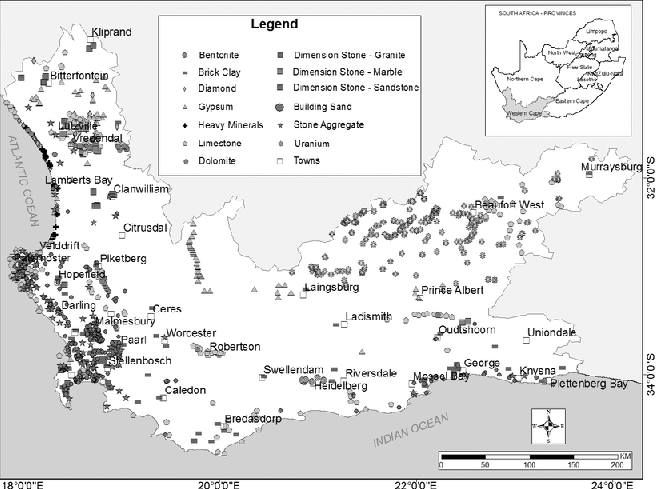
Map of the mineral potential of the Western Cape
Western Cape Mines currently operating:
- Vredenburg Limestone Quarry owned by Afrisam
- De Hoop Brick Clay Mine, owned by De Hoop Bricks
- Malmesbury Aggregate Quarry owned by WG Wearne
- Piketberg Sand Mine, owned by West Coast Sand and Stone
Read more about the Geology of the Western Cape
Frequently Asked Questions
Was there ever a gold rush in the Western Cape?
Yes. Small gold rushes occurred near Knysna (Millwood), Prince Albert, and Lion’s Head, but none became long-term profitable mining operations.
Is there still mining in the Western Cape today?
Yes. Modern mining continues mainly on the West Coast, including zircon, ilmenite, and rutile,heavy mineral sands and in parts of the Karoo, including uranium exploration.
What is rutile used for?
Rutile is a titanium-rich mineral used in aircraft parts, industrial coatings, ceramics, plastics, and advanced manufacturing.
Was manganese mined in Cape Town?
Yes. Manganese was mined at Hout Bay in the early 1900s, but operations were short-lived and eventually closed.
What happened to the Millwood Goldfields?
The Millwood Goldfields near Knysna peaked in the 1880s but were abandoned after only a few years due to low yields and difficult mining conditions.
Was there silver mining in the Western Cape?
There were attempts at silver mining, especially around Silvermine (Steenberg), but no commercially viable silver deposits were ever confirmed.
What is kaolin, and where was it mined?
Kaolin is a fine white clay used in ceramics and industry. It was mined in areas such as Fish Hoek Valley and processed for commercial use.
Why did early mining fail in the Western Cape?
Most deposits were too small, too difficult to extract, or not economically viable compared to richer mining regions in South Africa.
You may be interested in other Western Cape historical articles
- Colourdots is an independent regional information resource for the Western Cape.
Learn more about the project HERE
