
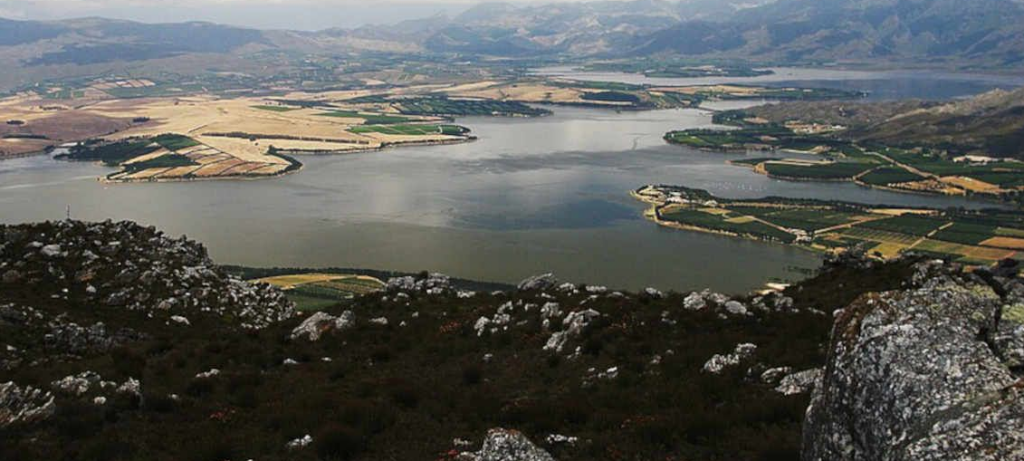
This guide covers the main dams in the Western Cape, how they work, and links to individual dam listings.
Jump to: What is a Dam |Design and Engineering |Evaporation and Water Loss |Key Dams |
|How the System Works |Storage and Capacity |Risks and Failures |Dam Levels
What is a Dam
A dam is a barrier built across a river to store or control water. It creates a reservoir that can be used for drinking water, irrigation, industry, and recreation.
Dams have been used for thousands of years. Early examples include structures built in ancient Egypt and China, while some Roman dams in Spain are still in use today.
Modern dams are designed to:
- store water for dry periods
- control flooding
- supply agriculture and towns
- generate hydroelectric power
Water is released through controlled systems such as spillways and sluices, ensuring rivers continue to flow downstream.
Why Dams Matter
Dams serve several practical purposes:
- Water storage for domestic, agricultural and industrial use
- Flood control during heavy rainfall
- Irrigation for farming areas
- Hydroelectric power generation
- Recreation, including boating, fishing and tourism
They also have environmental impacts, including changes to river flow, water temperature, and fish migration. Modern dam management aims to balance these effects.
Design and Engineering
Most modern dams fall into two main types:
- Concrete gravity dams
- Built in narrow valleys
- Use their weight to hold back water
- Earthfill or rockfill dams
- Built across wide valleys
- Use compacted material to form large barriers

Glossary of dam-building terms
Evaporation and Water Loss
All dams lose water through evaporation, especially in summer.
Factors affecting evaporation:
- temperature
- wind
- humidity
- sun exposure
Large, shallow dams like Theewaterskloof Dam are more affected than deeper reservoirs.
Key Western Cape Dams
The Western Cape has a Mediterranean climate, which means we have wet winters and long, hot, dry summers. The primary water supply system serving Cape Town is located in the Cape Fold Mountains.
Dams fill during winter rainfall and are drawn down through summer. Seasonal drops in water levels are normal; this is how the system is designed to work.
Most major dams in the province were built between the 1950s and 1990s and form part of an interconnected supply system serving cities, agriculture, and industry.
Some of the largest and most important dams include:
- Theewaterskloof Dam – 480 million m³ (largest in the province)
- Greater Brandvlei Dam – 459 million m³
- Voëlvlei Dam – 168 million m³
- Berg River Dam – 130 million m³
- Clanwilliam Dam – 121.8 million m³
- Wemmershoek Dam – 58.6 million m³
These six major dams provide almost all of the region’s stored water capacity. The smaller Steenbras Dam in the Hottentots-Holland is also part of this system. See also Molteno reservoir and “5 dams on Table Mountain”
See a list of major Western Cape Dams here.
How the System Works
The Western Cape dam system is interconnected. The six main dams and some of the smaller dams are part of an interlinked system, they are connected with pipelines, tunnels and distribution networks
- A tunnel links the Theewaterskloof Dam and the Berg River Dams through the Franschhoek mountains. Water can be transferred between dams depending on supply and demand. Runoff from mountain catchments feeds multiple reservoirs, which allows water to be stored efficiently and moved to where it is needed.
-
Storage and Capacity
- Total number of dams in the Western Cape: ±1,300
- Total surface area: ±33,000 hectares
- Total storage capacity: ±2.4 billion cubic metres
About 90% of the dams are used for irrigation, with many of them privately owned.
The ten largest dams alone hold over 1.6 billion cubic metres of water.
Read more about the geology of the Western Cape
Notable Facts
- Water in Wemmershoek Dam is of the highest quality due to minimal upstream activity
- Voëlvlei Dam was created from a natural marsh system
- The Western Cape’s largest dams are smaller than major inland systems like the Vaal
See our illustrated guide to freshwater fishing in the Western Cape and the best fishing locations
Risks and Failures
Although engineered for safety, dam failures can occur. In 1981, heavy rainfall and floods wrecked Laingsburg as a result of the collapse of the original Floriskraal Dam wall. There was serious flood damage near Malmesbury (2025), where multiple dams failed. These disasters can cause severe flooding, damage to infrastructure and disruption of services.
Western Cape Dam Levels
For current levels, see:
https://afriwx.co.za/state-of-dams/western-cape-province-dam-levels.jpg
Summary
Dams are essential infrastructure in the Western Cape. They store winter rainfall, supply towns and farms, and stabilise water availability through long dry summers.
They are highly engineered systems, interconnected across the region, and central to both daily life and long-term water security.
Take a virtual tour of Western Cape regions and attractions
- Colourdots is an independent regional information resource for the Western Cape.
Learn more about the project HERE