
- Province: Western Cape
- District; Overberg
- Coordinates:34°26′30″S 19°27′20″E
- Area:3.92 km2
- Municipality: Overstrand
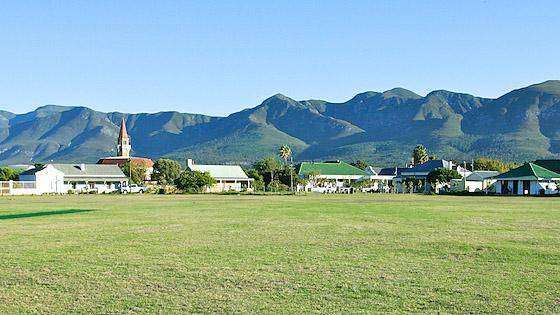
Stanford is a small town in the Western Cape, situated in the Overberg region along the banks of the Klein River. It lies east of Hermanus and north of Gansbaai. Stanford is surrounded by farmland and wetlands and is close to the Klein River estuary and nature reserve.
History of Stanford
Wheat mill and other innovations
This village was established on the farm Kleijne River Valleij, which was granted to Christoffel Brand by the British government in 1801. The farm changed hands several times and was then bought in 1838 by Irishman Robert Stanford, who retired from the British Army on “Half pay” after having served in Burma. He made several improvements, including building a wheat grinding mill on the stream close to his house. He was also forward-thinking and entrepreneurial, so he bought a boat to transport goods by sea over False Bay to Cape Town, instead of dragging wagons over the Hottentots Holland, which was far more time-consuming.
The Neptune scandal.
Stanford’s fortunes changed dramatically in 1849 when the British convict ship Neptune arrived at the Cape carrying Irish prisoners. The local colonists responded with a widespread boycott, refusing to supply the ship, the army or the government. Stanford, still an army officer on half-pay and therefore bound by his duty to the Crown, was ordered by Governor Sir Harry Smith to provide meat and bread. He complied, apparently believing that his duty required him to do so.
His decision made him deeply unpopular with the local colonists. He was ostracised, workers left his farms, and local businesses and professionals refused to deal with him. His family also suffered, with the refusal of doctors to attend his seriously ill child becoming one of the most notorious aspects of the story. Financially ruined and under enormous personal pressure, Stanford returned to England to seek compensation from the British government. In 1850, Queen Victoria knighted him, but the financial assistance he received was insufficient to restore his fortunes. He eventually fell into poverty in Manchester.
Meanwhile, his former farm in the Cape was sold at public auction. In 1857, Philippus de Bruyn subdivided part of the property and laid out a village, which he named Stanford in honour of its former owner. Sir Robert Stanford never returned to see the settlement bearing his name. He died poor in England, while the farm that had contributed to his downfall became the foundation of one of the Western Cape’s best-known heritage villages.
Group Areas Act defined by Mathilda May
In the early 1960s, when the “Group Areas Act” was being enforced and coloured families were moved to Die Skem, one stalwart, Mathilda May, held out, refused to move and remained in her house in Langmark Street till she died in the 1980s. Many other people still speak of the sadness of being removed from the houses where they were born and raised.
The whole village was declared a Heritage Site. In 1992, the Stanford Conservation Trust was formed to ensure the protection and conservation of the environmental and heritage resources in the area. Stanford is the 3rd most preserved village in the Western Cape.
Stanford is one of the very few towns in South Africa where the entire central historic core has been declared a Heritage Protected Area. Because of this strict conservation, the village operates like a living museum. You cannot change a window pane or paint a wall in the historic district without strict municipal approval. This preservation keeps quirks like the original mid-1800s water furrow system (leiwater) fully functional, channelling fresh water right past the historic doorsteps of the Cape Victorian cottages just as it did two centuries ago.
The Stanford Wine Route
The license plate prefix for Stanford is CEM, and the postcode is 7210 (Streets and Boxes)
local WEATHER TODAY
Browse businesses and places to visit in Stanford
Things to see and do in Stanford
- Flouhoogte pass
- A territorial flock of local geese have been a permanent fixture of local village life for generations, confidently walking down the middle of the road, stopping traffic, and acting as self-appointed security guards.
- Salmonsdam Ravine Trail
- Klein River
- Panthera Africa Wild Cat Sanctuary
- Stanford in bloom (spring)
- The 100-year-old Stanford Hotel
- Visit wine farms in Stanford
- The Haarkapper Trail, from Phillipskop, follows the route taken every Saturday by a farmer from Tesselaarsdal to cut people’s hair. From the mid-1920s, for more than 20 years, he walked the 20 km over the Klein River Mountains to and back.
- Stanford is the third most preserved heritage village in the Western Cape. Get the ‘Historical Stanford on foot’ brochure from the Stanford Tourism Office 028 3410 340
- See one of the oldest houses still in existence in the Cape Overberg.
- Hikes, Horse Riding and MTB trails (see listings)
- The Stanford village market and Saturday morning stoep markets are open from 09.00 to noon and are located down the length of Queen Victoria Street.
- The Stanford Walking Trail (Wandelpad) winds its way along the banks of the Klein River
- Hike or take a guided tour of Platbos Indigenous Forest, home to some 1000-year-old trees,
- Go horse riding on the beach or in the mountains with the African Horse Company
- Visit the Willem Appel Dam off De Bruyn Street to see a huge variety of birds. There’s a wooden hide for twitchers to use. Get the key from Stanford Tourism in Queen Victoria Street for a small refundable deposit.
- Do the antiques and collectables crawl? There are several wonderful troves in the village
- Phillipskop Mountain Reserve
Resources
Practical information for the Western Cape: regulations, permits, and helpful tips. See the Colourdots coastal and nature use guide

Useful Numbers
Residents and visitors can find important local contact numbers below, including police, medical services, utilities, and community facilities
-
Emergency Services
- Police: 028 341 0601
- Fire: 24-Hour Emergency line: 028 313 8000/8111
- Fire Brigade: 028 312 2400
- Ambulance: 10177 or Overstrand Medical Response-078 699 6995
-
Medical
- Closest hospital;Hermanus Provincial Hospital-028 312 1166
- Clinic – 028 341 0933
- Pharmacy Clicks Pharmacy – Hermanus-028 313 0270
-
Municipal & Utilities
- Municipality– 028 341 8500
- Water:028 341 8500
- Electricity:028 341 8500
-
Transport & Roads
- Traffic Department: Hermanus Traffic Department-028 313 8111
- Road Emergencies / SANRAL: 0800 204 204
-
Community & Safety
- NSRI 087 094 9774
- 24-hour Poisons Information Helpline of the Western Cape: 0861 555 777.
- SPCA: Stanford Animal Welfare Society- 072 318 1519/064 881 2294 sawsstanford@gmail.com
-
Local Contacts and Community Resources
- Tourism office in Queen Victoria Street 028 341 8516 stanfordtourism@overstrand.gov.za
- Community hall 028 341 0640
- Post office;Hermanus Post Office-028 312 1500
- Library: 028 341-0640
-
Schools in Stanford
- Okkie Smuts Primary School-028 341 0611
- Die Bron Primary School-028 341 0830
Other towns and suburbs in the Overstrand area include: Birkenhead; De Kelders; Elim; Fisherhaven; Franskraalstrand; Gansbaai; Hawston; Hermanus; Kleinbaai; Kleinmond; Pringle Bay; Rooi Els; and Struisbaai
- Colourdots is an independent regional information resource for the Western Cape.
Learn more about the project HERE