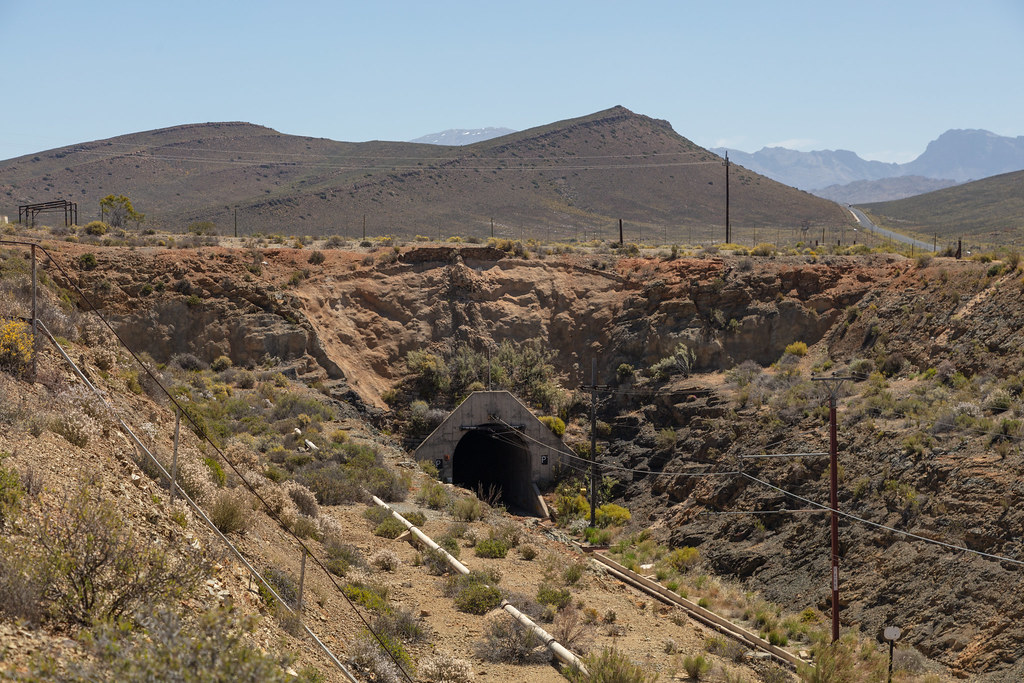
Hex River Tunnels
The Hex River Tunnels are a system of four railway tunnels located on the main Cape Town to Johannesburg rail line in the Hex River Mountains of the Western Cape, South Africa. The route runs between De Doorns in the Hex River Valley and Touws River in the Great Karoo. It was built to eliminate one of the most difficult sections of railway in South Africa, where steep gradients and tight curves through the mountains previously created a major bottleneck.
In total, the system consists of four tunnels: one twin tunnel of approximately 500 metres, and three single tunnels measuring about 1.1 km, 1.2 km, and 13.5 km. Together, they carry a significant portion of the railway line underground, with around 16.8 km of the route passing through tunnels.
Early Railway Challenges
The Hex River Mountains form part of the Cape Fold Belt, a major natural barrier between the coastal plain and the interior plateau. This made early railway expansion extremely difficult. In 1872, the Cape Government authorised the construction of a railway line through the region as part of a wider plan to connect Cape Town to the interior and the diamond fields at Kimberley.
Survey work began in 1874 under engineer Wells Hood, who identified a possible route through the Hex River Valley and over the mountains via Osplaas and Matroosberg. The terrain was extremely challenging, requiring steep gradients of around 1 in 40 and sharp curves that limited train size and speed. A short tunnel was included on the original line, which became the first railway tunnel in South Africa.
This early route was completed in the late 1870s and became part of the main rail connection between Cape Town and the interior. However, it remained a difficult section of track for more than a century.
Early Tunnels and Upgrades
The original tunnel served for more than 50 years before increasing rail traffic and larger locomotives required improvements. In 1929, a second concrete-lined tunnel was constructed alongside the original to ease the curve and improve clearance. This allowed continued use of the route but did not fully solve the operational limitations of the mountain pass.
By the mid-20th century, it became clear that a more modern solution was needed. The steep gradients and sharp bends still slowed trains and limited capacity on one of South Africa’s most important rail corridors.
Construction of the Tunnel System
In the 1940s, engineers proposed a major realignment of the railway through the Hex River Mountains. The plan involved constructing a series of long tunnels to bypass the old mountain pass entirely. Work began during the Second World War era but was delayed multiple times due to funding shortages, changing priorities, and difficult geological conditions.
Construction was carried out in stages over several decades. Work on some tunnels began in the 1940s, with further progress in the 1960s and 1970s. The final and longest tunnel, measuring approximately 13.5 km, was completed in the late 1980s. At the time of completion, it was the longest railway tunnel in Africa.
The system officially became operational in 1989. It significantly improved rail efficiency by reducing travel time, easing gradients, and eliminating the need for heavy banking locomotives on the mountain section.
Engineering Features
The longest tunnel passes through solid mountain rock with significant overburden above it. Ventilation shafts were constructed to support airflow and safety during operation. Some sections include widened internal profiles to allow trains to pass or to accommodate electrification requirements.
The completed system reduced the ruling gradient on this section of line to approximately 1 in 66 and significantly shortened the effective distance and curvature of the route. This made it far more efficient for both freight and passenger services between Cape Town and the interior.
The Old Pass Today
After the tunnel system opened, the original Hex River rail pass was closed. Sections of track were removed, but parts of the old railway alignment remain. Today, sections of the former line are used for recreational access and adventure tourism, including hiking and 4×4 routes through the mountains.
The Hex River Tunnels remain one of the most important railway engineering projects in South Africa, representing more than a century of planning, construction, and adaptation to one of the country’s most challenging landscapes.
Find out more about railways in the Western Cape
Read more about the Geology of the Western Cape
Is this your business?Claim it now.
Make sure your information is up to date.Colourdots is an independent Western Cape regional information resource. Learn more about the site here.