
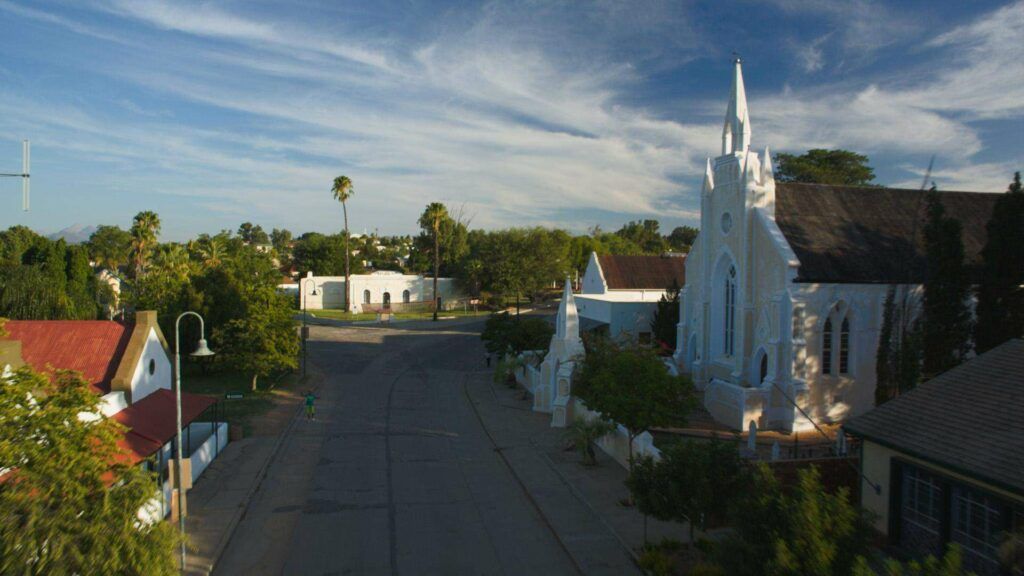
- Province: Western Cape
- Coordinates 32°10′43″S 18°53′28″E
- Area 15.27 km2
- District: West Coast
- Municipality Cedarberg
Clanwilliam lies approximately 220 km north of Cape Town on the N7 highway. The town sits at the foot of the Cederberg Mountains along the Olifants River and serves as a gateway to the wider Cederberg region. Clanwilliam Dam is located just outside the town and is a key water source for agriculture and recreation.
History of Clanwilliam
Clanwilliam, one of South Africa’s ten oldest towns, was established in 1806 and originally called Jan Disselsvlei. It is located at the confluence of the Olifants and Jan Dissels Rivers, on the western slopes of the Cederberg Mountains. The town initially served as a strategic stopover for travellers between the Western Cape and northern regions.
The area’s recorded history dates back to 1660 when a Dutch expedition led by Jan Danckaert reached the Olifants River, naming it after the elephants seen along its banks. The first farm in the valley was granted in 1732 to Pieter van Zyl. Initially part of the Stellenbosch district, Clanwilliam was declared a sub-district in 1808. In 1814, Sir John Cradock renamed the settlement after his father-in-law, the Earl of Clanwilliam.
The 1820 Settlers
In 1820, British settlers arrived in the Cape under an immigration scheme aimed at reinforcing the English-speaking population and stabilising the eastern frontier. Four Irish-led groups were granted land near Clanwilliam, totalling 126 men, 73 women, and 159 children. They were allocated specific farms:
However, many settlers found the conditions too harsh and requested transfers to the Eastern Cape. By 1825, only a few Irish families had stayed, with surnames like Foster, Fryer, Shaw, and McMahon. Despite their small numbers, they played a significant role in the town’s development.
There are many historical buildings in this little town, like the old farmhouse of Disselsvalleij and the Officers’ Residence in Park Street, as well as an original 1820 settlers’ home.
Religious and Social Development
Until 1826, the town fell under the Tulbagh church district, with some residents attending the Zwartlandkerk in Malmesbury. Ministers from Tulbagh visited annually for sacraments and baptisms. In 1815, Rev. Marquard, originally sent to work with the local coloured population, settled in Clanwilliam. After leaving his mission under the London Missionary Society, he joined the Colonial Reformed Church and remained in the town as an independent missionary.
For more than eighty years, Roodezand and Zwartland were the nearest churches. The priest from Tulbagh visited once a year for the sacraments.
The Dutch Reformed Church, which was built in the 19th century, became a central institution in the community. It was declared a national monument in 1973. Harold Cressy, the first coloured South African to earn a university degree in Cape Town, carried out mission activity in the area
Infrastructure and Modernisation
The Bulshoek Dam was built on the Olifants River to support irrigation in Vredendal. The Clanwilliam Dam was completed in 1935 and overflowed for the first time on August 15 that year.
Transportation improved with the opening of the N7 national road between Citrusdal and Clanwilliam in 1958 and between Clanwilliam and Klawer in 1963.
In 1901, Clanwilliam gained municipal status, with Charles Fryer, a descendant of Irish settlers, serving as the first mayor. The town grew steadily. In 1964, it received its coat of arms, symbolising the citrus industry and the Olifants River. The motto, “Toujours Prêt” (Always Ready), was inspired by the Clanwilliams of Scotland.
Rooibos Tea
Development in the 20th Century
By the mid-20th century, Clanwilliam had transformed into a modern rural town. A hydroelectric generator installed in 1938 provided electricity for most of the year, with an upgrade in 1958. The town’s water supply was also improved that year.
A memorial library, costing R20,000, was built in 1958 and named after Dr C. Louis Leipoldt, a renowned poet and medical doctor who spent his childhood in Clanwilliam, and Dr P. Le Fras Nortier, the pioneer of the seedless orange tree.
Today, the town stands as a key landmark in the Cederberg region, blending heritage with progress. The construction of the Clanwilliam Dam reshaped farming practices in the valley. The dam improved irrigation reliability, expanded agricultural capacity, and played a key role in the production of citrus and other crops.
The local Velskoen factory produces 50,000 hand-finished shoes in 10 styles and 20 different colours.
The license plate prefix in Clanwilliam is CAR, and the postal code is 8135
local WEATHER TODAY
Browse businesses and places to visit in Clanwilliam
Things to See & Do in Clanwilliam
- Ou Tronk Museum
- The Cederberg agricultural show is in April
- The wildflower show in September on Facebook
- 17 km outside Clanwilliam, driving towards Wupperthal, is the grave of C.L. Leipoldt, well-known paediatrician, botanist, cook, and poet
- Clanwilliam Expo– Annual Agricultural Show-083 382 1888
- Rooibos route info@rooibos-route.co.za
- St John’s church, completed in 1866, was designed by Sophia Gray, wife of Robert Gray, the bishop of Cape Town. It was built to serve the descendants of 1820 settlers in the district
- Rooibos tea tasting experience 078 364 8785
- The Dutch Reformed church was built in 1864 and was designed by Carl Otto Hager.
- Clanflora is a free mobile app for the wildflower enthusiast https://app.clanflora.co.za/
- Take a “voicemap” guided walking tour
- A historical walkabout through the centre of town 084 870 0001
- Short walks/hikes from Algeria Forest Station 027 482-2403
- See other trails in the area
- Parkrun Graafwaterweg 079 116 9497 velskoendraai@parkrun.com
- Brand see Berg pass
- Witelskloof pass
- Uitkyk Pass
- Maalgat hike
- The Ramskop Wildflower Garden has 350 species of cultivated wildflowers. There is also a Tea Garden open in August and September, Tel 027-482-2024.
- – Freshwater angling in the Olifants River and Clanwilliam Dam is popular.
- Doring River offers white water rafting adventures from mid-June to September, the river winds through the Cederberg
- The Doring (Doorn) concrete bridge was built in 1930 after a wooden bridge built in 1895 was washed away in the 1925 floods. The wooden bridge was 1 mile upstream from the current concrete bridge. There was a toll booth on top of Botterkloof at the time.
Resources
For permits, fishing rules, shell collecting regulations and other practical outdoor information, see the Colourdots coastal and nature use guide

Useful Numbers in Clanwilliam
Residents and visitors can find important local contact numbers below, including police, medical services, utilities, and community facilities
-
Emergency Services
- Police– 027 482 8181
- Fire: 027 482 1775
- Ambulance: 10177/027 482 2576
-
Medical
- Closest Hospital-027 482 2166
- Clinic-027 482 1692
- Pharmacy;027 482 1226
-
Municipal & Utilities
- Municipality; 027 482 8000
- Water; 027 482 8600
- Electricity: 027 482 8600
-
Transport & Roads
- Traffic Department; 027 482 8016
-
Community & Safety
- NSRI 087 094 9774
- 24-hour Poisons Information Helpline of the Western Cape: 0861 555 777.
- Childline South Africa: 116
- Veterinarian – Dr. Degenaar – 082 890 1181
- SPCA: Clanwilliam animal welfare 027 482 2333/ 082 264 5122.
-
Local Contacts and Community Resources
- Library – 027 482 8013 Nortier Leipoldt library
- Post office-027 482 1112
- Museum; Ou Tronk Museum – 073 613 8443
- Tourism; (0)27 482 2024
-
Schools in Clanwilliam
- Sederberg Primary School-027 482 1014
- Clanwilliam Secondary School – 0274821708
Clanwilliam https://www.cederberg.com/cederberg-accommodation-4.php
Towns in the Cederberg district include: Citrusdal; Elands Bay; Graafwater; Lamberts Bay; Porterville; Redlinghuys; and Wupperthal
Frequently Asked Questions
Where is Clanwilliam located?
Clanwilliam is in the Cederberg region of the Western Cape, about 230 km north of Cape Town via the N7.
What is Clanwilliam known for?
It is famous for rooibos tea, the Cederberg mountains, rock art sites, citrus farming, and the Clanwilliam Dam.
What outdoor activities can I find in Clanwilliam?
Yes. The area offers hiking, rock climbing, trail running, mountain biking, water activities at the dam, and scenic drives.
Can visitors explore San rock art?
Yes. There are several rock art sites around the Cederberg, including guided options from nearby lodges.
Is swimming allowed at Clanwilliam Dam?
Yes, the dam is used for swimming, boating, and fishing. Always check local safety notices and conditions.
Are there shops and fuel stations?
Clanwilliam has supermarkets, local shops, a fuel station, pharmacies, and essential services.
Does Clanwilliam have places to eat?
Yes. The town has cafés, restaurants, takeaways, and farm stalls on nearby routes.
Is the town suitable for families with children?
Yes. Outdoor areas, farm stays, the dam, and local attractions are family-friendly.
How do I get to Clanwilliam?
Drive the N7 north from Cape Town (around 2.5 hours). The town is easy to access from the highway.
What medical and emergency services are available?
Clanwilliam has a hospital, clinic, police station, and fire and municipal services.
What towns are close to Clanwilliam?
Nearby areas include Citrusdal, Lamberts Bay, Graafwater, and Wupperthal (via mountain passes).
- Colourdots is an independent regional information resource for the Western Cape.
Learn more about the project HERE