
The Battle of Blaauwberg (1806):
How the Cape Changed Hands
On the morning of 8 January 1806, a short, sharp battle was fought on the sandy plain east of Blaauwberg mountain. It lasted barely two hours. There were no grand fortresses stormed, no dramatic last stands. And yet, the Battle of Blaauwberg permanently changed the course of southern African history.
That morning marked the end of Dutch rule at the Cape and the beginning of more than a century of British control. The consequences would shape the Cape Colony, the Union of South Africa, and eventually the modern country itself.
Why the Cape mattered
To understand why Britain sailed halfway around the world to fight on a windswept plain, you have to understand the Cape’s position in the early 1800s.
Britain was at war with Napoleonic France, and the Netherlands at the time,” The Batavian Republic, was aligned with the French. The Cape sat directly on Britain’s most important sea route: the long passage between Europe and British India; whoever controlled the Cape controlled resupply, repairs, and safe harbour on that route.
Britain had already occupied the Cape once before, in 1795, then handed it back under the Treaty of Amiens in 1802.
A secret British expedition
In mid-1805, Britain quietly assembled a large fleet. Sixty-plus ships left ports in England and Ireland under the command of Commodore Sir Home Popham, carrying more than 6,500 professional soldiers led by Major-General Sir David Baird.
The destination was deliberately obscured. Officially, the fleet was bound for the Mediterranean or the East Indies. In reality, the destination was the Cape of Good Hope.
Unbeknownst to the fleet, events in Europe were moving fast. Admiral Nelson defeated the French at Trafalgar in October 1805, ending the threat of a French invasion of Britain. But the Cape expedition was already far out at sea.
The Cape is unprepared
At the Cape, command rested with Lieutenant-General Jan Willem Janssens. He knew an invasion was likely but had little to work with. His forces were small, mixed, and unevenly trained. They included: Dutch and Batavian regular infantry, German and Hungarian mercenaries (the Waldeck battalion), French sailors and marines from stranded ships, Khoi soldiers, burgher militia, mounted farmers, and enslaved men who were used to move the artillery
In total, Janssens could muster roughly 2,000 troops, supported by limited artillery. His best regiment had already been sent overseas. Morale was fragile. Communication was slow. By the time reports confirmed a large British fleet was approaching, there was little time left to prepare.
The British arrive
On 4 January 1806, lookouts on Signal Hill watched sails gather on the horizon. The British fleet anchored between Robben Island and Blaauwberg.
An initial landing attempt failed due to heavy seas. Eventually, British troops disembarked at Losperd’s Bay, today’s Melkbosstrand, on 6 and 7 January.
The landing was chaotic. Rough surf overturned boats. Thirty-six Highland soldiers drowned when one vessel capsized. Had Janssens attacked decisively at this moment, the outcome might have been very different. But he did not. By nightfall on the 7th, the British army was ashore, exhausted, thirsty, and vulnerable but still intact.
Janssens chooses to fight
Rather than defending Cape Town from prepared positions, Janssens made a bold and risky decision. He marched north to confront the British before they could advance on the city.
On the night of 7 January, his force camped near Rietvlei. At dawn, he moved his men onto the plain east of Blaauwberg, forming a defensive line across the veld. He later admitted that victory seemed impossible, but believed honour demanded resistance.
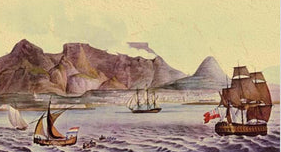
The battlefield
The battle was fought on open ground, with Blaauwberg mountain to the west and a wide plain stretching toward Cape Town to the south.
The British advanced in two brigades on one side, a disciplined line of infantry on the other side, the Highland regiments, advancing through sand and scrub in full uniform.
Janssens placed his most experienced mercenaries, the Waldeck battalion, at the centre of his line, with Khoi soldiers, French marines, and artillery on either side. At sunrise, artillery fire opened the engagement.
The collapse
As British infantry closed the distance, Janssens hoped his centre would hold. Instead, the opposite happened.
The Waldeck mercenaries broke first, retreating without firing a shot as the Highlanders advanced. Their flight exposed the entire Batavian line.
French marines and Khoi soldiers fought stubbornly. Artillery crews, many of them enslaved men from Mozambique, kept firing until they were overrun. But once the centre collapsed, the battle was lost.
Janssens ordered a retreat. By mid-morning, the field belonged to Britain. British losses were relatively light: around 200 casualties. Janssens lost more than 300 men, many through desertion rather than death.
Cape Town falls
On 9 January, British troops marched toward Cape Town. To avoid bombardment, the city’s commandant raised a white flag.
Formal surrender terms were signed on 10 January 1806 under a tree in Woodstock, later known as the Treaty Tree. The tree can still be seen there today.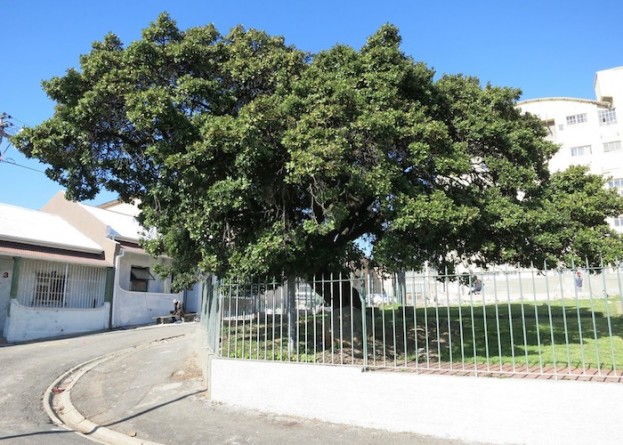
Janssens did not surrender immediately. He withdrew into the Hottentots Holland Mountains, hoping in vain for French reinforcements. After a week, with his force dwindling, he capitulated on 18 January.
What changed, and what didn’t
The terms were surprisingly generous. Batavian soldiers were allowed to return home. Property rights were largely respected, and civil administration continued with minimal disruption.
But politically, the change was decisive.
Although the Cape was only formally ceded to Britain in 1814, British rule from 1806 onward was uninterrupted. The Cape would remain under British control until it became part of the Union of South Africa in 1910, and within the Commonwealth until 1961.
Why the battle still matters
The Battle of Blaauwberg is easy to overlook. It was short, uneven, and it lacked drama. Yet it shaped the language and legal systems of the Cape, patterns of land ownership, military and administrative control of southern Africa and Britain’s dominance of the sea route to the East.
Housing estates and shopping centres now cover the ground where troops once advanced through sand and fynbos. What remains is the view and the knowledge that history turned in a few hours of movement, exhaustion, fear, and resolve.
The Battle of Blaauwberg may not have been large, but it was final.
- Colourdots is an independent regional information resource for the Western Cape.
Learn more about the project HERE
