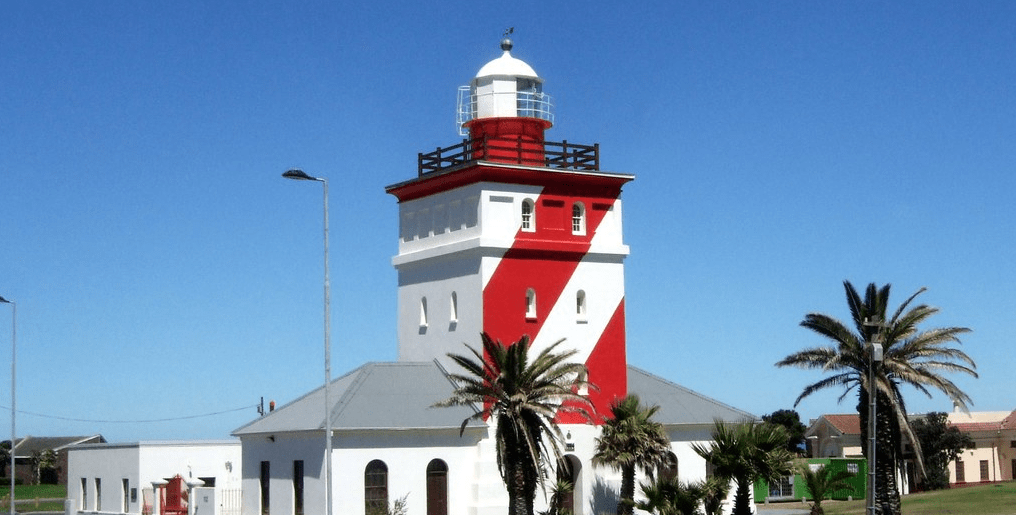
Green Point Lighthouse and Mouille Point Lighthouse
Green Point Lighthouse is often confused with the former Mouille Point Lighthouse, but they were two separate structures, built nearly 20 years apart.
After some violent storms in 1741, the Dutch East India Company decided to move their ships to Simon’s Town for the winter months. They also began to build a breakwater at Granger Bay; however, the project failed due to the work consistently being swept away by the rough seas, and the project was abandoned. However, in 1781, the French managed to build a breakwater and called it Mouille Point, which is French for “anchorage..
Green Point Lighthouse was the first lighthouse built in South Africa. It was commissioned by Sir Rufane Shaw Donkin and designed by Herman Schütte, and built between 1821 and 1823. The light was first lit on 12 April 1824
It was later raised to 16 metres in 1865. It is the oldest operational lighthouse in the country.
It was the first solid lighthouse structure on the South African coast and is the oldest operational lighthouse in the country. Originally, the lantern and dome were painted in yellow and black stripes. It was repainted in 1956. When it was first operational, the lighthouse was equipped with Argand lamps, which burned sperm whale oil, a common fuel source in the 19th century.
In 1922, 3rd order dioptric flashing lights were installed, extending the lighthouse’s range to 22 nautical miles, or about 41 kilometres. Today, the lighthouse emits a powerful white light that flashes every 10 seconds, with an intensity of 850,000 candela; it is visible for up to 25 nautical miles.
The lighthouse also included a foghorn that sounded for three seconds every 30 seconds. Locals called it Moaning Minnie. The foghorn was replaced in 1986 with an electric horn.
Greenpoint lighthouse is said to be haunted by a one-legged lighthouse keeper. There was a lighthouse keeper by the name of WS West, who was nicknamed “Daddy West” However, he mysteriously disappeared. His voice it is claimed, echoes along the walls at night
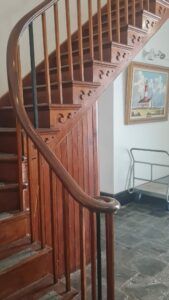
Staircase inside Greenpoint Lighthouse
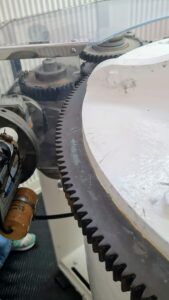
Light mechanism
Mouille Point Lighthouse was the second lighthouse built in South Africa. . It was located on the northeast side of Table Bay in Granger Bay to warn ships of the dangerous rocks at Mouille Point. The original lighthouse, designed by Charles Michell and completed in 1842, had a pyramidal shape. It was replaced by the second lighthouse, which had a cylindrical tower shape and is still partly extant, in 1865
At Granger Bay, near the present-day Cape Peninsula University of Technology. A tall plastered brick tower was built, and an octagonal lantern was imported from France. The cylindrical tower was painted with red and white bands. The light used 730 gallons of sheep tail oil every year. This oil was stored in a 4 m deep hollow foundation within the bedrock.
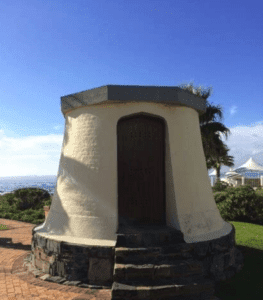
This lighthouse was also somewhat inefficient, did not survive the harsh sea conditions, and the Lighthouse Commission recommended it be switched off in 1890 when the Granger Bay breakwater was completed. A beacon was placed here, which was also decommissioned in 1906. It was partially demolished a few years later, sometime in the 1920s. What remains of the structure is the circular base with a concrete slab over it. During the Second World War, it was used as a searchlight platform. It is currently used as a store area/garden tool space,

The Mouille Point lighthouse was switched off in 1890 when the Granger Bay breakwater was completed. A beacon was placed here, which was also decommissioned in 1906. It was partially demolished a few years later.
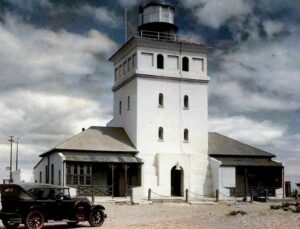
Greenpoint Lighthouse circa 1920”.
The Green Point lighthouse is a national heritage site open to the public for a fee. Contact 021 449 5171 to book.
Even after Green Point lighthouse was commissioned, ships still wrecked at the entrance to Table Bay. See the comprehensive list of shipwrecks around the Western Cape Coast
100 Beach Road, Mouille Point,
33°53’57.1″S 18°24’42.0″E