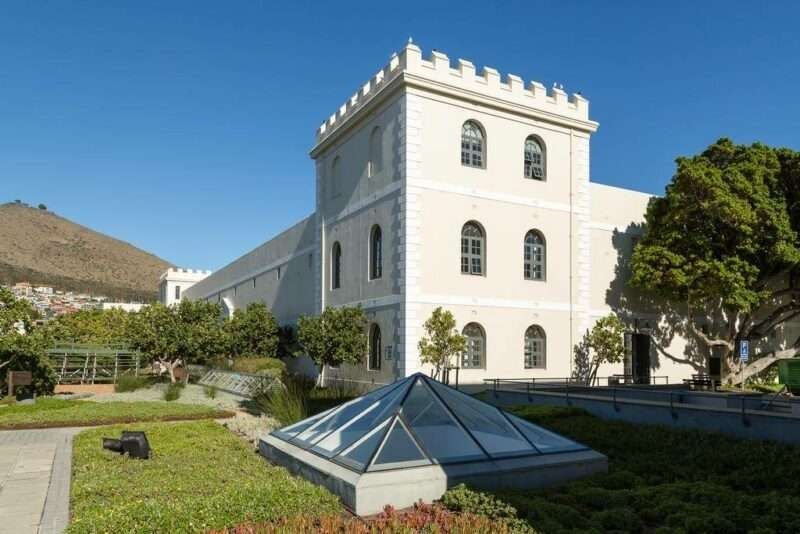
Breakwater Gaol
The Breakwater Prison, also known as the Breakwater Gaol, was constructed in 1860 to house British convicts employed on building the breakwater that enabled Cape Town’s harbour to be developed. A quarry below the prison, near the site of today’s Two Oceans Aquarium, supplied hard rock that was transported by hand-powered rail wagons up the hill and through a tunnel. Many inmates had been convicted of petty crimes, including escaping forced naval service in England, offences that carried sentences of hard labour.
The building visible today is the Industrial Breakwater Prison, a national monument designed with four castellated turrets and an enclosed courtyard, based on the Millbank and Pentonville prisons in England. It functioned as a prison for only about ten years. In 1891, white prisoners were moved into this building, making it the first site in South Africa to racially segregate black and white convicts. Before segregation, a white convict was required to sleep between two black convicts, on the belief that language and cultural barriers would limit plotting and dissent.
The prison gained a reputation as one of the most feared in the world, with stories claiming inmates from almost every known nationality were held there. After a strike in 1885, during which black and white convicts met together in the yard, authorities enforced stricter racial separation. The prison also included a punishment block with a human-powered treadmill used both as labour and punishment.
Several notorious criminals passed through the prison. Percy Collingwood, a safe breaker who managed to open a prison safe with his bare hands. “Frenchie” Ferroli, another inmate, escaped by dressing in a warder’s uniform and calmly walking through the prison gates
After its brief period as a prison, the building became a juvenile offenders’ institution, and from 1926 to 1989 it served as a hostel for black dock workers.
The prison finally closed in 1923. The complex was repurposed rather than being demolished. In 1970, the buildings were declared a National Monument under the old National Monuments Council legislation.
Since 1991, it has housed the Breakwater Lodge and the University of Cape Town Graduate School of Business within what is now the Victoria & Alfred Waterfront. Traces of its past remain, including graffiti carved into the stone walls by inmates and the nearby Gallows Hill area, which was once part of the prison complex, long before Robben Island was used as a prison. Gaol
Portswood Road, V & A Waterfront,
Is this your business?Claim it now.
Make sure your information is up to date.Colourdots is an independent Western Cape regional information resource. Learn more about the site here.