
- Province: Western Cape
- Coordinates: 34°9′48″S 18°25′47″E
- Municipality: City of Cape Town
- South Peninsula
- Area: 0.62 km2
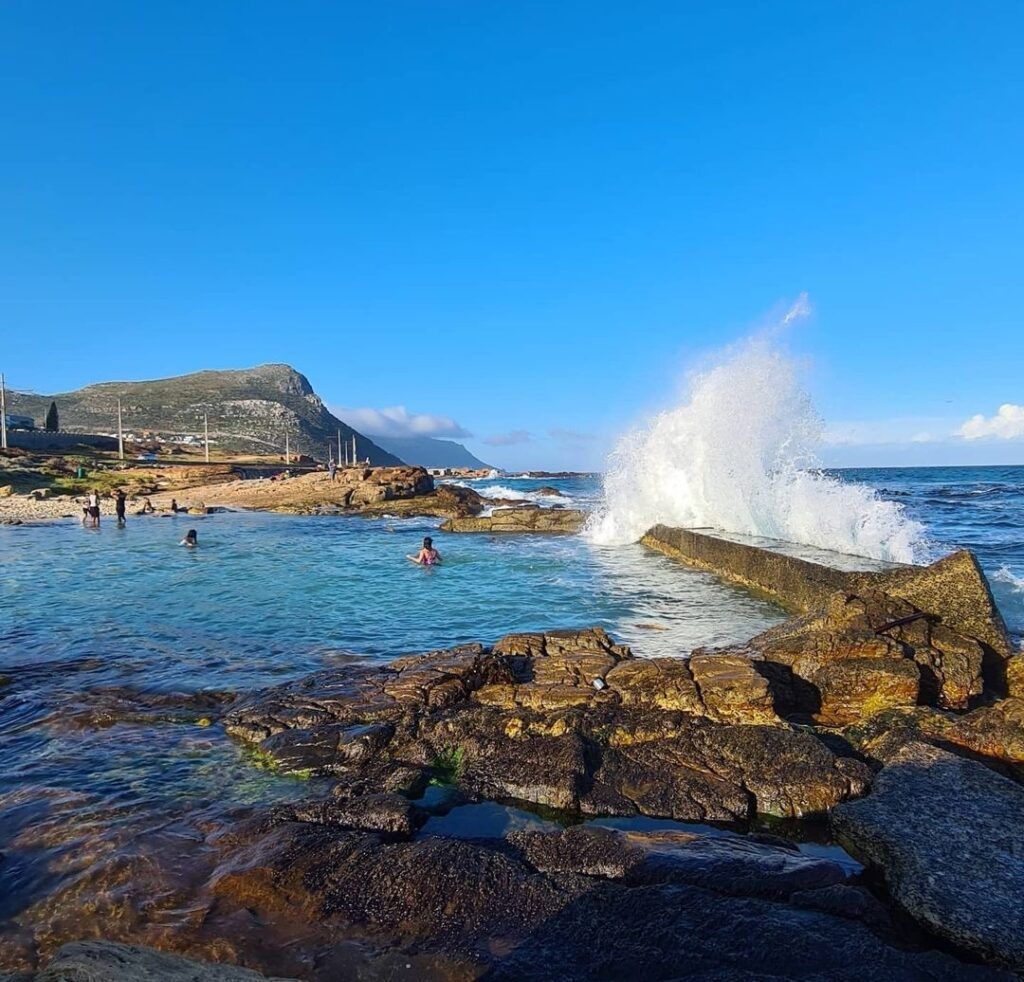
Glencairn is a small coastal village on the False Bay coastline of the Western Cape, situated between Simon’s Town and Fish Hoek. It features a sheltered bay with a sandy beach, surrounded by low hills and natural fynbos vegetation.
History of Glencairn
Glencairn lies about 4 km north of Simon’s Town in the Els River valley. The area was originally known as Elsjes Baai, after the river, which appeared as the Elze River on an 1870 map. The origin of the name Glencairn is associated with Scottish residents of the area, and Scottish businessman John Henderson is said to have named his property Glencairn after a glen in Scotland. The name was eventually adopted for the settlement.
The valley was originally agricultural. Christoffel Brand farmed vegetables along the Elsjes River, while a tannery operated at Elsjes Baai. Other farms included Hartenbosch, now part of Da Gama, and Brooklands. Further up the valley was Welcome Cottage Farm, where a mill was built to grind grain for local farmers. The mill was probably constructed around 1820 by J. H. Brand. The farm was transferred to merchant Thomas Brownrigg Wools in 1828, and the mill was still operating when the property was auctioned in 1842. It was bought by Frances Bateman Pinney, who continued vegetable farming. The remains of the mill are within the South African Navy sports grounds.
Glencairn later became an important source of building stone for Simon’s Town. The Glencairn Quarry opened in 1898 and was a source of sandstone and quartzite for construction, including the Simon’s Town Naval Dockyard. Barges transported the stone across False Bay. The quarry was closed for a period during the First World War and later operated under Strong & Moore before finally closing in 1978. The old quarry is now used by the False Bay Sport Shooting Club.
In 1902, the Cape Glass Factory was established in Glencairn. The factory used sand from the extensive dunes that once covered much of the valley. Ohlsson’s Cape Breweries had a substantial interest in the business, but the venture was unsuccessful and closed after only three years. The factory attempted to manufacture bottles entirely by machine, but the process was not successful. Excavations in the area have since uncovered remnants of the short-lived operation.
Glencairn’s natural environment is also part of its history. The Glencairn Vlei, a wetland behind the beach, provides habitat for African clawless otters, which use both the freshwater wetland and the surrounding coastline.
Remains of military structures can also be found in the hills above Glencairn Heights. These formed part of the coastal defence system protecting the approaches to Simon’s Town during the Second World War. Some of the abandoned concrete structures remain visible to hikers today.
The coastline and valley have long been used by fishermen and other local residents, while the wetland, beach, quarry and surrounding mountains have given Glencairn a varied history despite its relatively small size.
The postcode in Glencairn is 7975
local WEATHER TODAY
Browse businesses and places to visit in Glencairn
Things to See and Do in Glencairn
- The Beach: Is popular for dog walking, windsurfing and kite-surfing
- Glencairn Wetlands: These are protected and populated with Indigenous fauna and flora, with great bird-watching opportunities
- Glencairn Quarry .
- Cape Glass Factory The ruins of the Cape Glass Company Ltd, a sadly short-lived enterprise, can be seen at Glencairn Heights.
- Glencairn Mill . The ruins of this mill are at the South African Navy sports ground
- Whale Watching: In-season
- Excellent hiking routes in the mountains
- (Sacred site )Pyramid All-seeing Eye, This site embodies a fiery, male energy and looks oddly like the symbol on US dollar bills. dean@sunpath.co.za
- At 3122 Glen Road in the valley, on a slope in a natural fynbos area, is a labyrinth with one-meter-wide paths and two-meter-wide borders of indigenous plants. 0834840294
- Scuba Diving around the wreck of The Clan Stuart, which ran aground in 1914.
- –Glencairn Tidal Pool, which was built in the 1920s
Resources
Practical information for the Western Cape, Regulations, permits and helpful tips. See the Colourdots coastal and nature use guide

Useful Numbers in Glencairn
Residents and visitors can find important local contact numbers below, including police, medical services, utilities, and community facilities
-
Emergency Services
- Police: 021 786 8646
- Fire: 0214003908
- Ambulance: 10177
-
Medical
- Closest hospital: False Bay Hospital-ER- 021 782 1121
- Municipal & Utilities
- Electricity: 0860 103 089
-
Transport & Roads
- Water: 0860 103 089
- Traffic department: 021 786 8646
-
Community & Safety
- NSRI 087 094 9774
- 24-hour Poisons Information Helpline of the Western Cape: 0861 555 777.
- Childline South Africa: 116
- SPCA: Cape of Good Hope SPCA-021 700 4140
-
Local Contacts and Community Resources
- Post office; Fishhoek 021 782 2916
- Schools: The closest schools are in Fish Hoek
- Colourdots is an independent regional information resource for the Western Cape.
Learn more about the project HERE
Updated November 2025