
 On this page:
Check the mountain, not the App
Cape Town has a reputation for unreliable weather. One moment fine, the next, a chilly wind sweeps in from the Atlantic. Locals describe it as“four seasons in one day”.
Why is Cape Town’s weather so changeable?
Cape Town’s weather is confusing. One hour, it’s bright and windless. Next, the wind pumps. This is caused by the geography of the peninsula that lies between two bodies of water. The icy Benguela Current drifts up from Antarctica on the Atlantic side, while False Bay is somewhat affected by the Agulhas Current and is a bit warmer.
A gentle sea breeze can turn into a gale in minutes. Rain can suddenly appear, and then the weather will clear in a flash.
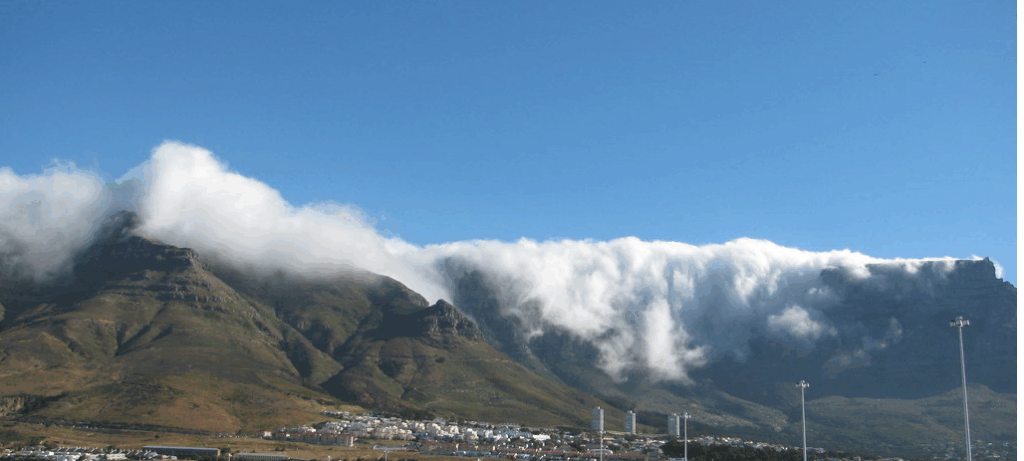
Table Mountain is the weather-maker. The flat-topped mountain creates its own climate. Moist air from the ocean rises, cools, and condenses against the cliffs, forming the iconic “tablecloth” of cloud.
In the city, it may feel cool and misty. Then drive a few km to the Atlantic coast, and you’ll find sunshine and blue skies. These Cape Town microclimates are why the weather app is so often wrong‘
The Cape Doctor
This is a strong south-easterly wind that sweeps across the peninsula, usually during the summer months. It can ruin your beach day, but it also clears pollution and keeps the skies blue.
When the south easter blows, it rains in Gauteng. It is all connected.
The local saying that is not even hyperbole, perfectly describes Cape Town weather: “four seasons in one day.”
. Morning sun, afternoon wind, and chilly evenings, maybe even a spot of rain, all before sunset and then you may need a jacket, or not? You never know
However, the crisp, clean air and clear, luminous light of the long summer afternoons make for great sunsets and stunning pictures.
So what makes it so windy?
Cape Town has long been known as a windy city, particularly from late spring into early summer when the famous south-easter dominates. Wind is created by differences in air pressure, with air moving from areas of higher pressure towards areas of lower pressure. The bigger the pressure difference, the stronger the wind.
The Western Cape lies on the eastern edge of the South Atlantic high-pressure system, which plays a major role in shaping the region’s weather. During summer, this system drives the familiar southeasterly winds across the Cape Peninsula. As moist air rises over the mountains, it cools and condenses, forming mist and light precipitation along the slopes. Although the Western Cape is known for winter rainfall, as much as a quarter of the Peninsula’s annual rainfall can occur during summer, often after the passage of cold fronts.
Cape Town’s windiest months are generally November to February, with January usually the windiest month. May and June tend to be calmer. Rainfall also varies dramatically across the Peninsula, ranging from around 400 mm to over 2,270 mm per year. This is influenced not only by altitude but also by the direction slopes face and the shape of the landscape, which can channel and concentrate moisture-bearing winds.
Locals adapt to the weather. The saying goes, “There is no problem with the weather, just with your wardrobe.” You may need sandals, scarves, sunglasses and an umbrella, often all at once. Flexibility helps. If the mountain disappears into clouds or the wind is too strong for hiking, the winelands are often a good alternative. Beach visits are usually best planned for early in the day before the wind strengthens around midday.
Link to Windguru: Check expected wind direction and speed
When to visit Cape Town
It is best to work with the rhythm of the Cape Town weather. Each time of year shows a different side to the city, from golden beach days to misty mountain mornings. There’s not really a best time to visit. It depends on what you love to do, whether you like long, sunny beach days, misty forest walks or cosy fireside wine-filled afternoons.
Summer in Cape Town (November-February)
Daytime temperatures are usually between 25 and 30 degrees Celsius, though the Cape Doctor wind often keeps things cooler. The Atlantic Ocean is cold, making swimming refreshing, brisk and brief.
Enjoy sunsets on the Atlantic seaboard, open-air concerts and city nights. Always carry a light jacket; the air can get quite cold when the sun goes down.
Autumn in Cape Town (March-May)
Autumn in Cape Town makes for some of the best days. The wind calms, the air softens, and the crowds thin out. Temperatures are usually between 18 and 25 degrees. The vineyards turn yellow and orange and are quite spectacular.

Winter in Cape Town (June-August)
The cooler Winter days are between 12 and 18 degrees C. Sometimes there are soft, gentle showers, sometimes driving rain and sometimes clear, crisp sunny days with no wind. Winter is the season for fireplaces and red wine. The whales visit the coast in the winter months.
Sometimes Cape Town will experience a Berg Wind. This is a northerly wind from the interior that is gentle and warm. The weather can get quite hot. These days are beautiful and great for a beach visit, but within the next day or two, heavy rain is guaranteed.
Spring in Cape Town (September-October)
Temperatures rise to 20 degrees C. This is the time the Western Cape flower carpet blooms. The show depends on the amount of rain that fell during the winter. The weather is pleasant, and a good time for adventuring before the crowds arrive.
- For long sunny days, summer is best.
- For quiet days and golden light, choose autumn.
- For cosy evenings and wild weather, winter is the time. It is not called the Cape of Storms for nothing.
- Spring is when the Western Cape puts on the spectacular flower display.
What to Pack for Cape Town Weather
Packing for Cape Town weather is an art; be positive but prepared. Locals have learned to prepare for the “four seasons in one day”. Begin with comfortable basics, add a warm layer, and finish with something windproof /waterproof. The mornings can feel cool, the afternoons warm, and the evenings cool again.
It is wise to always carry a light jacket even in summer. In winter, a soft jumper and a rainproof jacket will see you through. It does not get very cold in Cape Town.
Cape Town packing list:
- Lightweight cotton basics
- A ight, waterproof jacket/windbreaker.
- walking shoes.
- A warm jumper for cooler evenings,
- A sun hat,
- Swimming costume in summer
- Waterproof shoes in winter.
Cape Town Travel Tips for Every Possibility.
- If Table Mountain is covered in clouds, it may get very windy. Clouds around Lion’s Head and nowhere else mean rain within 12 hours. Clear skies above the mountain? You’re in for a clear but perhaps windy day.
- Capetonians will check the mountain before looking at the weather app.
- Plan a flexible itinerary. Sunny one place could mean misty on the mountain.
Interactive map of the Cape Peninsula
Cape Town Microclimates
Newlands is the wettest area in Cape Town. The mountain slopes push the sea breeze up, forming clouds, causing rain.
Most coastal suburbs are windy. This includes Hout Bay, Camps Bay, and Gordon’s Bay. Particularly in the Deep South, where the wind forms a funnel through the valley from Fish Hoek to Kommetjie/Noordehoek. Some beaches are protected by aspects or boulders.
Inland areas, like Stellenbosch and Paarl, tend to have more extreme temperatures. Temperatures will always be a bit hotter in summer and a bit colder in winter than in Cape Town.
Temperatures are also generally hotter in more built-up, developed areas like Woodstock, the City Bowl, and the Cape Flats
- On the Atlantic side of the peninsula, the air can be cool and misty, while False Bay is sunny. Choose your side!
- If the wind is blowing in Camps Bay, they head to the False Bay coast.
- If it is cloudy in town, the Southern suburbs may be nicer, or go north towards Blouberg.
- The West Coast is often sunny when it is raining in the Southern suburbs.
- The confusing unpredictability of Cape Town’s weather keeps locals and visitors on their toes.
- Stay flexible and enjoy different activities in different weather.
CT Weather Office: 021 934 0749 / 0831 Weatherline: 083 123 0500
Western Cape Cold Fronts explained
Contrary to popular belief, the winter cold fronts that affect the Western Cape do not simply “arrive from Antarctica”. They form as part of large weather systems that move eastwards around the Southern Hemisphere in a band of strong westerly winds known as the Roaring Forties.
These weather systems develop over the Southern Ocean and South Atlantic, carrying cold polar air northwards towards the Cape. As the cold front approaches, it meets warmer air over the interior of South Africa.
Ahead of the front, dry offshore “berg winds” often develop. These warm winds blow from the interior down towards the coast as air is drawn towards the approaching low-pressure system. Berg winds can make conditions unexpectedly hot and dry just before a cold front arrives.
When the colder, denser air behind the front forces the warmer, moist air upwards, the air cools and condenses into clouds. Once the air reaches the dew point, rain begins to fall. This is why the arrival of a winter cold front in the Western Cape is often accompanied by rain, strong winds, and a sudden drop in temperature.
A Typical Winter Weather Pattern in the Western Cape
- Day 1: High pressure dominates with southeasterly or variable winds and relatively clear conditions.
- Day 2: An approaching low-pressure system causes winds to swing to the northeast or east, bringing warm, dry berg winds from the interior.
- Day 3: Winds shift anticlockwise to the northwest. High cirrus clouds begin appearing ahead of the approaching cold front.
- Day 4: The cold front passes. Winds swing to the southwest, temperatures drop sharply, and rain spreads across the Western Cape. Snow may fall on high mountains.
- Day 5: The front moves eastwards. Showers begin clearing as high pressure builds in behind the system.
- Day 6: Cool southwesterly conditions persist before the next high-pressure system settles over the region.
Watching wind direction changes and cloud formations is often one of the best ways to anticipate approaching winter weather in the Cape.
Check WindGuru for wind speed and direction
Here is a link to the weather app anyway
FAQs about Cape Town weather.
What is the best month to go to Cape Town?
December to February, during summer, is the most popular time for visiting Cape Town. March and November are also great times, especially if you want to enjoy the good weather without large crowds of tourists and the high prices of peak season.
Does Cape Town get windy?
Yes, the summer brings in the southeaster wind, locally known as the ‘Cape Doctor’. Before winter cold fronts, there is often a dry Berg wind.
Does it ever snow in Cape Town?
Light snow occasionally falls on Table Mountain and the surrounding ranges in winter.
What is the average sea temperature in Cape Town?
The sea temperature in False Bay is typically 3-6 °C warmer than the Atlantic Seaboard side.
- False Bay side: Peaks in February at 19.2°C and falls to 14.4°C in August.
- Atlantic Seaboard side: Peaks in February at 17°C and falls to 14.2°C in August.
See also Tips for travellers to the Western Cape
Browse our complete Western Cape guide to find comprehensive lists with practical details
Colourdots is an independent regional information resource for the Western Cape.
Learn more about the project HERE