
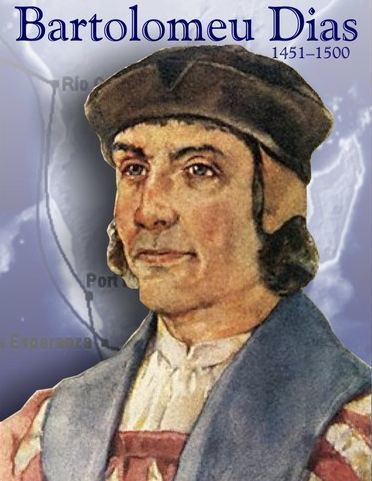
Bartolomeu Dias was one of the most important explorers of the Age of Discovery. In 1488, he became the first European navigator to sail around the southern tip of Africa, proving that the Atlantic and Indian Oceans were connected. His voyage opened the sea route between Europe and Asia and changed world trade forever.
Very little is known about Dias’s early life, although he came from a family with strong maritime connections. One of his ancestors, Dinis Dias e Fernandes, explored the West African coastline during the 1440s and reached the Cap-Vert Peninsula in present-day Senegal. Portugal was rapidly expanding its exploration of Africa during this period, searching for trade routes, gold, and access to the East.
By the late 1400s, Portugal had become Europe’s leading seafaring nation. Under kings such as John II of Portugal, explorers were sent further and further down the African coast. The Portuguese hoped to find a direct sea route to India that would bypass the expensive overland trade routes controlled by Middle Eastern and Mediterranean powers.
In 1481, Dias joined an expedition led by Diogo de Azambuja to build the fortress and trading post of São Jorge da Mina on the Gulf of Guinea in West Africa. Historians also believe he may have sailed with the explorer Diogo Cão during earlier expeditions along the African coastline toward the Congo River.
By 1486, Bartolomeu Dias was serving in the Portuguese royal household and supervised the royal warehouses. King John II selected him for an ambitious new expedition to continue exploring Africa and to search for the legendary Christian ruler known as Prester John, who Europeans believed lived somewhere beyond the Islamic world, possibly deep within Africa or Asia.
Bartolomeu Dias departed from Lisbon around 1487 with three ships. The expedition included two caravels, São Cristóvão and São Pantaleão, and a supply ship captained by his brother Diogo Dias. Some of Portugal’s best navigators joined the voyage, including experienced pilots who had previously sailed with Diogo Cão.
The fleet travelled steadily down the west coast of Africa, placing stone markers called padrões at important points along the route to claim territory for Portugal. By December 1487, Dias had reached present-day Namibia and anchored near modern Walvis Bay.
From there, Dias made a bold decision. Instead of hugging the coastline, he sailed southwest into the open Atlantic Ocean. Strong winds and storms drove the fleet far from land for almost a month. When the ships finally turned east and north again, the coastline they reached was no longer facing south. Dias realised they had sailed around the southern tip of Africa without even seeing it.
On 4 February 1488, the fleet landed at Mossel Bay. Bartolomeu Dias and his crew had achieved something no European had done before. They had found a route around the continent.
The expedition continued eastward for a short distance. Dias eventually reached Kwaaihoek near present-day Port Elizabeth, where another padrão was erected. However, supplies were running low, the crew was exhausted, and many sailors feared travelling further into unknown waters. Dias reluctantly agreed to turn back.
During the return journey, the expedition finally sighted the dramatic southern cape they had unknowingly passed earlier. Dias named it “Cabo das Tormentas” — the Cape of Storms — because of the dangerous seas and violent weather encountered there. King John II later renamed it the “Cape of Good Hope,” recognising the enormous possibilities the new route offered for trade with India and the East.
Dias returned to Lisbon in December 1488 after extending European knowledge of the African coastline by nearly 1,000 miles. His voyage proved that ships could safely sail around southern Africa by using the open ocean west of the coast instead of battling difficult currents close to shore.
Despite the importance of his discoveries, Dias received surprisingly little recognition at the Portuguese court. Nevertheless, his work laid the foundation for future voyages. Nearly a decade later, his discoveries allowed Vasco da Gama to successfully establish the first direct sea route from Europe to India in 1498.
Dias later helped prepare da Gama’s ships for this historic expedition, although he only accompanied the fleet as far as the Cape Verde Islands before returning home.
In 1500, Dias joined another major Portuguese expedition led by Pedro Álvares Cabral. The fleet first reached Brazil before turning east toward India. Tragically, Dias’s journey ended near the waters he had once conquered. On 29 May 1500, his ship was lost during a violent storm near the Cape of Good Hope.
Dias left behind a lasting legacy. His grandson, Paulo Dias de Novais, later became the first governor of Portuguese Angola and founded São Paulo de Luanda in 1576.
Today, Bartolomeu Dias is still remembered in South Africa. The Dias Cross at Cape Point stands alongside the da Gama Cross overlooking the ocean route that changed global history. The Bartolomeu Dias Museum Complex in Mossel Bay contains artefacts linked to early Portuguese exploration and includes a life-size replica of one of Dias’s caravels. His voyage around Africa remains one of the great turning points in world exploration and maritime history.
