
The Griqua people (also known as Griekwa, Korana or Koranna) are a distinct ethnic group in southern Africa, found mainly in South Africa, with smaller communities in Namibia and Zimbabwe. They are closely related to the Khoikhoi and developed through a process of mixing between Khoikhoi, San, and European settlers during the early colonial period.
The Griqua emerged on the frontier of the Cape Colony during the 18th century. Many were descendants of mixed communities made up of Khoisan people, freed slaves, and Europeans. Over time, these groups formed their own identity, leadership structures, and settlements, becoming one of the earliest organised mixed-heritage communities in the region.
Early Formation and Migration
The Griqua trace their origins to key family groups, including the Kok and Barends families. A central early leader was Adam Kok, who helped establish a community that would later move beyond the Cape Colony.
By the late 1700s and early 1800s, Griqua groups migrated north of the Orange River. With the support of missionaries from the London Missionary Society, they settled at Klaarwater, later renamed Griquatown. From there, they expanded into areas that became known as Griqualand West and Griqualand East.
These migrations were often driven by pressure from expanding colonial settlement and conflict with Boer farmers. Over time, different Griqua groups moved further inland and eastwards in search of land and autonomy.
Leadership and Society
The Griqua developed structured communities with elected leaders known as kaptyns (captains). Leaders such as Adam Kok II, Adam Kok III, and Andries Waterboer played important roles in guiding their people through migration, settlement, and conflict.
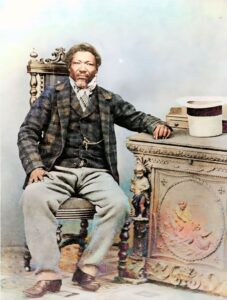
Adam Kok
In 1813, under missionary influence, the Griqua adopted a formal constitution, one of the earliest written systems of governance in the region. They established settlements, trade networks, and acted as intermediaries between inland African communities and the Cape Colony. This mission influence is also seen in places like Genadendal and Elim.
Conflict and Loss of Independence
During the 19th century, the Griqua became involved in regional conflicts and alliances. They often aligned with the British against the Boer republics, particularly as pressure on their land increased.
The discovery of diamonds in Griqualand West in 1867 intensified land disputes, eventually leading to British annexation of Griqua territories in the 1870s. These developments reduced Griqua independence and brought their lands under colonial control.
Kranshoek and the Southern Cape
In the early 20th century, a later phase of Griqua migration led to the establishment of new settlements in the southern Cape, including Kranshoek along the Garden Route.
This movement was led by Abraham le Fleur, a spiritual and political leader among the Griqua. Displaced from land near Kokstad, he guided his followers south in search of a permanent home. In 1904, he founded the Griqua National Conference and later the Griqua Independent Church.

Andries Le Fleur
Le Fleur, known as “the Reformer” and “die Kneg” (servant of God), believed he had received a divine calling to lead his people to this region. According to oral tradition, he described the area as one of abundance, with access to the sea for fishing and nearby land suitable for farming.
By 1927, Griqua families from across South Africa had joined the settlement. Initially, they leased land at the nearby farm Jakkalskraal, only securing ownership in 1957. This allowed for the development of a more stable and permanent community.
During the apartheid era, the area was further shaped by forced removals, with people of mixed heritage and Khoisan descent relocated to settlements such as Kranshoek. Despite this, the community retained a strong cultural identity, and the village remains an important centre of Griqua heritage today.
A monument erected in 1942 commemorates the Griqua pioneers, and the grave of Abraham le Fleur is in the area.
Culture and Identity
Traditionally, the Griqua were pastoralists, hunters, and traders. Over time, agriculture was introduced through missionary influence.
Today, the Griqua maintain a distinct cultural identity, despite being classified within South Africa’s Coloured population. Cultural traditions, language (Afrikaans), and community structures remain important.
Ceremonies such as Inabasas (a ceremony held to celebrate the virginity of young daughters) continue in some communities. They also perform different cultural dances, marking important life stages and reinforcing cultural values. The Griqua Concept Nxabasas speaks of a female goddess. Their beliefs respect water and nature.
Legacy of the Griqua
The history of the Griqua reflects migration, adaptation, and the search for independence on the colonial frontier. From early settlements at Griquatown to later communities such as Kranshoek, their story is closely tied to the broader history of South Africa.
Today, the Griqua are recognised as one of the country’s unique mixed-heritage communities, with a legacy that continues to shape regions across the Northern Cape, Eastern Cape, and Western Cape.