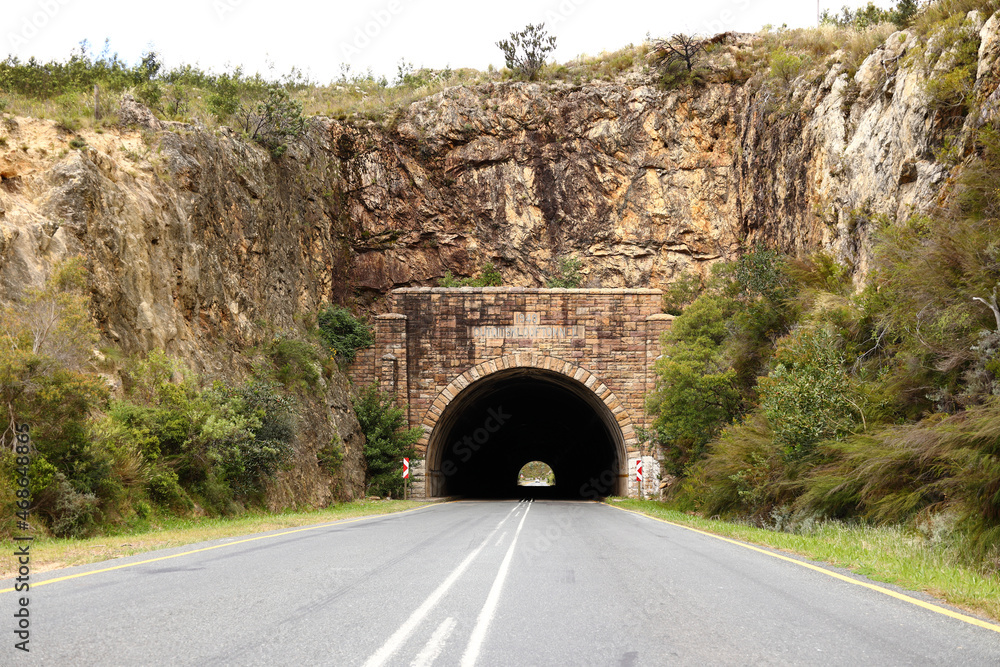
Du Toit’s Kloof Tunnel and Pass
The short tunnel on the historic Du Toitskloof Pass is often overshadowed by the much longer Huguenot Tunnel, but it forms part of one of the Western Cape’s most significant mountain roads. The tunnel is approximately 200 metres long and was completed as part of the new Du Toitskloof Pass, which opened in 1949.
The pass lies between Paarl and Worcester. Before the opening of the 3.9 km Huguenot Tunnel in 1988, it formed part of the N1 national road and was one of the main routes between Cape Town and the interior.
Early Routes Through the Mountains
The pass is named after François du Toit, a French Huguenot refugee who settled in the area during the late 17th century. For many years, the route through the mountains was little more than a cattle track used by farmers travelling between the Cape and the interior.
As farming expanded, there was a greater need for a proper road. In the early 1800s, Detlef Siegfried Schönfeldt, a German farmer and former cavalry officer, proposed the construction of a wagon road through Du Toitskloof. He persuaded farmers from Paarl, Worcester, Stellenbosch and Franschhoek to contribute funds and began work on the most difficult section of the route, known as Kleigat.
Although Schönfeldt succeeded in building part of the road, the project exhausted its funding. When government engineers later investigated the proposal, they concluded that the existing route was adequate and refused further support. The decision left Schönfeldt financially ruined, and the project was abandoned.
Several further proposals followed during the nineteenth century, but none got past the planning stage.
Building the Modern Pass
Interest in the route was revived during the 1930s as traffic volumes increased and better roads became necessary. Government engineer P.A. de Villiers surveyed a modern route through the mountains, and construction began during the summer of 1941–42.
A large part of the work was carried out by Italian prisoners of war held in South Africa during the Second World War. Many of the prisoners had experience in construction and engineering and worked on sections of the pass, including the tunnel.
The project was completed in 1949 at a cost of approximately £750,000 and was officially opened by Prime Minister D.F. Malan. The new pass provided a safer and more reliable route through the mountains and significantly improved travel between Cape Town and the interior.
The original Du Toitskloof Pass was approximately 48 kilometres long and climbed to an elevation of around 820 metres. In 1988, the Huguenot Tunnel opened, shortening the route by approximately 11 kilometres and bypassing much of the mountain pass.
Today, most traffic uses the toll tunnel, while the original pass remains one of the Western Cape’s most scenic mountain drives.
Although no longer the province’s primary route, Du Toitskloof Pass remains an impressive engineering achievement. Travellers can still experience the historic tunnel, dramatic mountain scenery and the route that generations of farmers, wagon drivers, engineers and labourers struggled to establish through the mountains.
Beyond its engineering history, Du Toitskloof offers a glimpse into the geology of the Western Cape, while the Mapping Museum in Mowbray highlights the surveying and mapmaking efforts that helped explorers, engineers and road builders navigate the region’s rugged terrain
The pass stands as a lasting monument to nearly two centuries of effort to connect the Cape interior with the coast.
Is this your business?Claim it now.
Make sure your information is up to date.Colourdots is an independent Western Cape regional information resource. Learn more about the site here.