
- Province: Western Cape
Winelands - Coordinates:33°53′56″S 18°57′57″E
- Area:0.64 km2
- Municipality: Stellenbosch
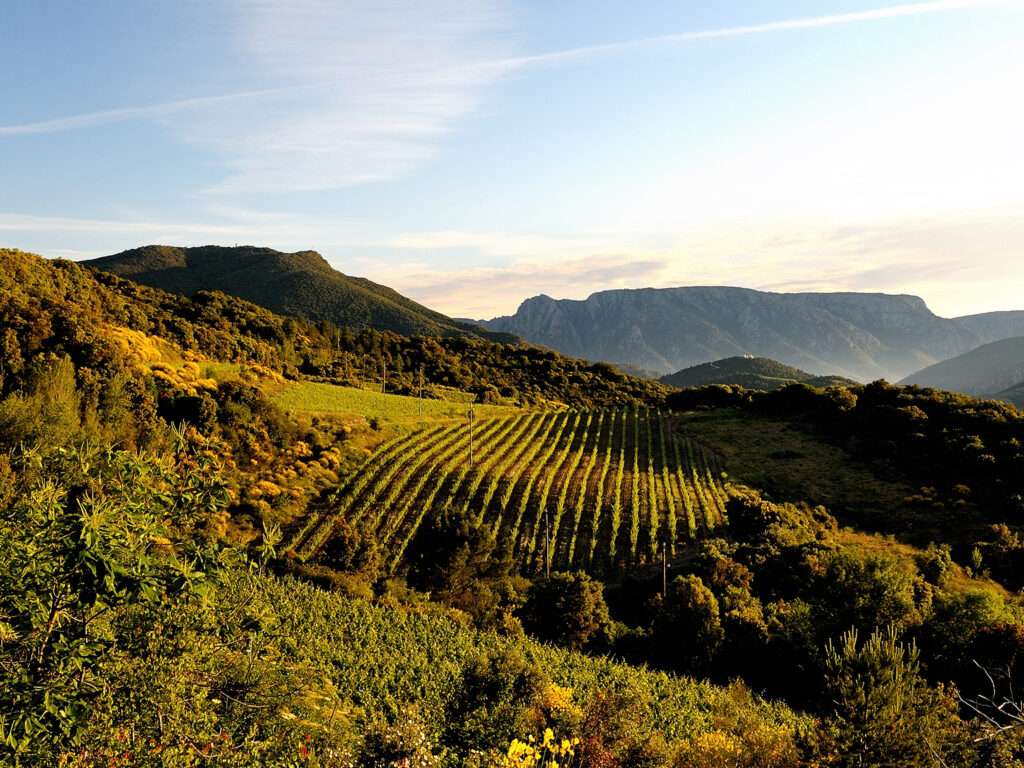
Languedoc is a small rural settlement in the Western Cape, located inland from the Overberg region. It lies near the R324, connecting it to neighbouring towns, and is surrounded by farmland and rolling hills. The area is primarily agricultural, with a quiet, close-knit community.
History of Languedoc
The village’s name traces all the way back to 1694, when the Dutch East India Company granted a farmto French Huguenot Jean Imbert from the French town of Nîmes in Languedoc. The Drakenstein area is historically significant for its mix of Huguenot refugees and Free Burghers (Vryburgers). The Huguenots, unable to teach their language, saw it largely disappear in the valley.
Slaves were introduced to the Cape Colony shortly after the settlers arrived in 1652. Initially, few farmers owned slaves, but as farms expanded, the demand grew, leading to a significant slave population in Drakenstein. Many of these slaves were skilled artisans, such as carpenters and wheelwrights.
Although the British Empire abolished slavery in 1834, slaves were required to serve an additional four years as apprentices. Many gravitated towards mission stations where they learned trades and received a basic education. In 1842, farmers Pieter Isaac de Villiers and Paul Retief donated land for freed slaves to establish a self-sustaining mission station, with local farmers providing further support by donating land for housing and agriculture.
The village you see today wasn’t built by farmers, but by the mining magnate and politician Cecil John Rhodes, who hired South Africa’s most famous architect, Sir Herbert Baker, to design the village layout. Baker designed 100 freestanding white-washed cottages complete with large private garden plots, a central supplies shop, a school, and a stone Anglican church.
Languedoc was modelled on Bournville Village in England. Bournville was a famous “garden village” built by chocolate maker George Cadbury to give his factory workers high-quality, green living spaces.
This area also has ties to Cecil John Rhodes, who, after resigning as Prime Minister of the Cape Colony, turned to fruit farming. Rhodes purchased old wine farms affected by phylloxera and replaced the vines with fruit trees, pioneering the use of refrigeration for shipping fruit to Britain. In 1898, Rhodes addressed the need to retain labour in the Cape, commissioning architect Herbert Baker to design the village of Languedoc for farm workers. Influenced by Cape Dutch architecture and the Arts and Crafts movement, each house featured a garden for flowers, vegetables, and space for livestock. This village, lined with oak trees, still stands today.
The reason Languedoc developed was the invention of refrigerated ocean transport. Before this, Cape farms focused almost entirely on wine or dried goods because fresh fruit would rot on the long voyage to Europe. When “reefer ships” were invented, Rhodes realised the Dwars River Valley could become a goldmine for fresh fruit exports to London
Rhodes also commissioned a cottage in Muizenberg due to his declining health, though it is unclear if he ever stayed there.
The license plate prefix for Languedoc is CL, and the postcode is 7680
Resources
Practical information for the Western Cape, Regulations, permits and helpful tips. See the Colourdots coastal and nature use guide
WEATHER IN LANGUEDOC TODAY
Browse businesses and places to visit in languedoc

Useful Numbers
Residents and visitors can find important local contact numbers below, including police, medical services, utilities, and community facilities in and around Languedoc. The main centre is Stellenbosch
-
Emergency Services
- Police: 021 809 5000
- Fire: 021 021 808 8800/ Fire Brigade 021 887 1333
- Ambulance: 10177
-
Medical
- Closest hospital;Stellenbosch Provincial Hospital-021 808 6100
-
Municipal & Utilities
- Municipality: 021 808 8111
- General enquiries:021 808 8215 / 021 808 8953 / 021 808 8343
-
Transport & Roads
- Traffic department:021 021 808 8800
-
Community & Safety
- SPCA: Stellenbosch Animal Welfare-021 883 9129
-
Local Contacts and Community Resources
- Post office; 021 886 7521
- Library:021 808 8384
- Find a comprehensive list of Cape Town emergency numbers
- Colourdots is an independent regional information resource for the Western Cape.
Learn more about the project HERE