
- Province: Western Cape
- District: Cape Winelands
- Coordinates:33°55′S 19°08′E
- Area:7.05 km2
- Municipality: Stellenbosch
Jump to: History of Franschhoek |Things to See and Do in Franschhoek |Useful Numbers in Franschhoek
</p
Franschhoek is a town in the Cape Winelands region of the Western Cape, about 75 km east of Cape Town. It lies in a fertile valley surrounded by the mountains of the Cape Fold Belt, including the Franschhoek Mountains. The town forms part of the wider Drakenstein Local Municipality and sits close to other wine-producing towns such as Paarl and Stellenbosch. The area is connected to surrounding towns by the R45 regional road, which links Franschhoek with the Berg River Valley and the broader Cape Winelands.
History of Franschhoek
After the revocation of the Edict of Nantes in 1685, many Protestants were forced to leave France. Between 1688 and 1689, about 200 Huguenots arrived at the Cape. The Dutch East India Company granted them land in a valley known then as Olifantshoek because elephant cows used the protected valley to raise their calves.
The Huguenots initially received farms in Drakenstein, where the soil quality was poor. They appealed to Governor Simon van der Stel to relocate to better farmland. In 1694, the governor allocated nine farms in the Olifantshoek area along the Franschhoek River. Later, farmers subdivided these farms and named them after regions in France. La Motte, Cabrière, Chamonix, La Dauphine, L’Ormarins, and La Provence, many of which still bear their original names. While retaining their culture, they were required to integrate into Dutch colonial society. Within two generations, the French language largely disappeared, replaced by Dutch.
The Huguenots brought agricultural expertise, transforming many of the original farms into renowned wineries where Cape Dutch buildings with French influence still stand. The first name was “de France Hoek” (The French Corner), which was later shortened to Franschhoek.
In 1805, Commissioner-General J.A. De Mist of the Batavian Republic renamed the area Franschhoek or La Petite Rochelle. The town became a municipality in 1881. A Dutch Reformed Church congregation was established in 1845, marking the growth of a permanent town. The construction of a railway branch line from Paarl to Franschhoek in 1904 improved access and trade, linking the valley more closely to Cape Town and the surrounding districts.
This town is relatively remote, with the valley surrounded by mountains on three sides. Elephants first made a track over the mountains, but it was too rough for wagons. Simon van der Stel organised slaves to build a road, expecting the project to take only a few months. However, in 1819, S.J. Cats created a more passable road. Known as “Cats se Pad,” this road remained in use until 1825, when Lord Charles Somerset used soldiers from the Royal African Corps to construct a new road. Builders erected a stone bridge at Jan Joubertsgat, named after a man who died there. This bridge, the oldest still in use today, served the road until 1933. In 1960, workers modified and tarred the road.
The arrival of the Huguenots significantly influenced the area’s culture and language. Many South African surnames, such as Malherbe, Terreblanche, Du Toit, Marais, and Du Plessis, trace their origins to these Huguenot settlers.
Wine in Franschhoek
The Franschhoek Wine Valley is known for its high rainfall, which is best for the production of some of the country’s most extraordinary Méthode Cap Classiques, Cabernet Sauvignon and Merlot varieties. The valley and wine route. has evolved into one of the Cape’s best viticulture and culinary regions. Visitors can experience some of the best wines paired with fine dining. Franschhoek has the reputation of being South Africa’s gastronomic capital. Read about wine making in the Western Cape and see a list of wine farms in Franschhoek
The postcode in Franschhoek is 7690
local WEATHER TODAY
Browse businesses and places to visit in Franschhoek
Things to See and Do in Franschhoek
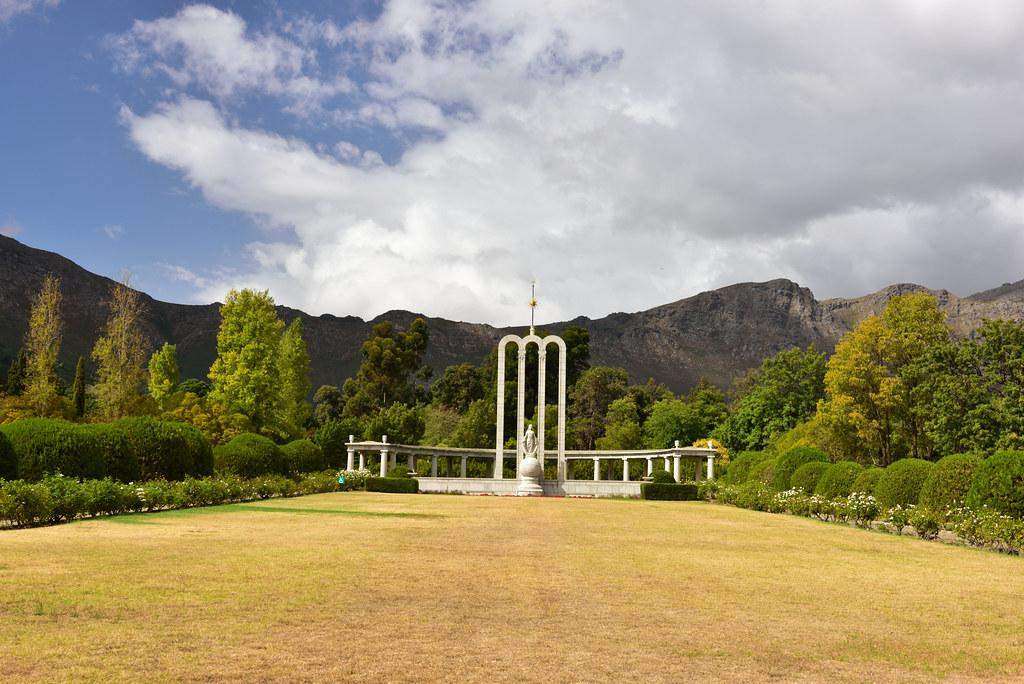
- The Huguenot Monument, which was erected in 1938 to celebrate the 250th anniversary of the arrival of the Huguenots at the Cape, was ceremonially inaugurated on 17th April 1948.
- Franschhoek open gardens, in aid of Fleur de Lis Age Home, held in October 073 535 0007
- Walking tours 072 999 8581
- Parkrun: Rickety Bridge Winery, Main Street, franschhoek@parkrun.co.za
- Drive through Leeu Estates to enjoy the natural beauty and the sculptures dotted throughout the estate.
- Mooiwater model township development
- Franschhoek Literary Festival
- Classic car festival
- Bastille Day in Franschhoek
- Chamber Music Festival.
- Franschhoek Uncorked
- Robertsvlei MTB trail
- Food and drink in Franschhoek
- Outdoor map
- Village market
-
Museums,
- Motor Museum-021 874 9002
- First South African Perfume Museum-072 342 4174
- Huguenot Memorial Museum– 021 876 2532
- La Motte museum
Resources
Practical information for the Western Cape: regulations, permits, and helpful tips. See the Colourdots coastal and nature use guide

Useful Numbers in Franschhoek
Residents and visitors can find important local contact numbers below, including police, medical services, utilities, and community facilities
-
Emergency Services
- Police: Saps -021 876 8061
- Fire: Paarl Brandweer-021 872 2323
- Ambulance:10177
-
Medical
- Closest hospital; Clinic-021 876 2172
- Pharmacy;Link Pharmacy-021 876 2261
-
Municipal & Utilities
- Municipality: 021 808 8700
- Water:021 808 8700
- Electricity:021 808 8700
-
Transport & Roads
- Traffic department: Stellenbosch -021 808 8800
- Community & Safety
- NSRI 087 094 9774
- 24-hour Poisons Information Helpline of the Western Cape: 0861 555 777.
- Childline South Africa: 116
- SPCA:021 876 4808
- Animal Clinic: 021 876 2504
- Animal Rescue: 076 327 4939
- Local Contacts and Community Resources
- Post office;Post Office-021 876 2342
- Local newspaper: Tatler 021 876 3460 info@franschhoektatler.co.za
- Heritage and Ratepayers Association: 082 445 3116
- Huguenot Association: 021 876 2598
- Library: Public Library-021 808 8406
- Tourism; 021 876 3603
-
Schools in Franschhoek
- Franschhoek High School-021 876 207
- Groendal Secondary School-021 876 2211
- Dalubuhle Primary School-021 876 3957
- Wes-Eind Primary School-021 876 2360
- Groendal Primary School-021 876 2448
- Bridge House School-021 874 8100
- Simond Privaatskool-021 874 1196
Colourdots is an independent regional information resource for the Western Cape.
Learn more about the project HERE