
Shipping Insurance: How It Started and How It Works
Early Origins of Insurance
The idea behind insurance, spreading risk, dates back thousands of years. As early as 1750 BC, the Code of Hammurabi included agreements where a loan for a sea voyage only had to be repaid if the ship arrived safely. If the ship was lost, the debt was cancelled. This was one of the earliest forms of maritime risk sharing.
In the Middle Ages, trade guilds developed similar systems. Members paid into a shared fund that could be used if a workshop burned down, goods were stolen, or a craftsman could no longer work. These early systems helped stabilise trade and support communities during losses.
By the 1600s, as global sea trade expanded, these ideas evolved into formal maritime insurance. Merchants and shipowners began sharing the financial risk of voyages, allowing trade to continue despite frequent shipwrecks and losses at sea.
At the same time, advances in mathematics, particularly the work on probability in the 17th century, helped insurers better assess risk. This made insurance more structured and reliable, laying the foundation for the modern systems still used today
The beginning of Lloyd’s shipping insurance
More formalised shipping insurance developed in the 1600s as global trade expanded and new sea routes were established. Sea travel was dangerous and unpredictable. Ships regularly faced storms, reefs, piracy and navigational errors, and a single wreck could ruin a merchant financially.
In London, merchants, ship captains and investors gathered at a place called Lloyd’s Coffee House. Here, shipowners would write down details of a voyage, the ship, cargo, destination and risks. They would ask others to share the risk. Wealthy individuals would agree to cover a portion of any loss, each signing their name underneath the proposal. This is where the term “underwriting” comes from.
Instead of one person risking everything, the danger was split among many. If a ship was lost, each underwriter paid their share. This system made long-distance trade possible, even when losses were common.
Over time, this informal system developed into the modern marine insurance market. Today, most ships are insured through large international markets, still based on the same principle: risk is shared between multiple insurers rather than carried by one company.
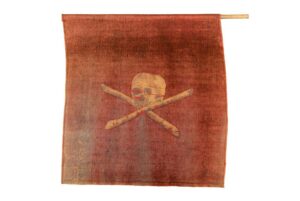
ThisJolly Roger flag was captured from a pirate captain in 1789
How Shipping Insurance Works
Before a ship leaves port, it is typically insured for several things:
- The ship itself (hull insurance)
- The cargo on board
- Liability, in case damage is caused to other ships or ports
Insurers assess the risk based on:
- The route
- Weather conditions
- The type of cargo
- The value of the ship
The total risk is then divided between multiple insurers, each taking a percentage. This ensures that even very large or valuable ships can be covered.
If something goes wrong, such as a grounding, storm damage, or total loss, the insurers pay out according to their share. This allows shipping companies to recover financially, even after major disasters.
Why Shipwrecks Were So Common
Before modern navigation, shipwrecks were a regular part of maritime trade. Poor maps, unpredictable weather and limited technology meant that many ships were lost along dangerous coastlines.
The Western Cape, in particular, became known for shipwrecks due to:
- Strong winds and storms
- Powerful currents
- Rocky, exposed coastlines
Insurance made it possible for shipping to continue despite these risks. Merchants could afford to send goods across the oceans, knowing that losses would be covered.
Why Insurance Still Matters
Even today, global trade depends on shipping insurance. Without it, most cargo vessels would not sail, as the financial risk would be too high.
The system has changed very little from its origins:
- Risk is still shared
- Voyages are still assessed individually
- Payments are made when losses occur
What began in a London coffee house now supports global trade, ensuring that goods continue to move across the world — even in the face of storms, accidents and shipwrecks.
See a list of ships wrecked around the Western Cape coastline
