Wagenaar’s Reservoir
When Jan van Riebeeck arrived at the Cape, he had a dam built to improve the settlement’s water supply, but it did not meet the needs of the growing settlement or the ships passing through Table Bay.
Zacharias Wagenaer
Born in Dresden on 10 May 1614, Zacharias Wagenaer had already worked in Brazil, Batavia and Japan before being appointed Commander of the Cape of Good Hope. He succeeded Van Riebeeck and took office on 6 May 1662. During his four years at the Cape, he concentrated on improving the settlement’s water supply and infrastructure, as well as relations with Khoikhoi communities. He was the only German Governor of the Dutch East India Company and commanded the Cape settlement from 1662 to 1666.
In 1663, the Heeren XVII, the Board of Directors of the Dutch East India Company, instructed Wagenaer to build a reservoir to improve the water supply. Work on a dam had begun during Van Riebeek’s administration, but Wagenaer completed the reservoir in 1663. It became known as Wagenaer’s Reservoir and supplied fresh water to both the settlement and ships arriving in Table Bay.
Employees of the Dutch East India Company, including soldiers, artisans and slaves, carried out the construction. They excavated into the bedrock and built stone walls and sluices to regulate the flow of water. Fed by the Fresh River, the rectangular reservoir measured approximately 45 metres long, 15 metres wide and 1.5 metres deep.
The water then had to be transported to the ships. Slaves rolled oak barrels to the reservoir, where they were filled before being taken back to the docks. There, the barrels were hooked to a crane and lowered onto small rowing boats, which carried the water out to the ships.
The system was extended in 1671 under the supervision of Wouter Mostert, a senior VOC official. A canal was constructed from the dam to the wharf, allowing the barrels to be filled closer to the shoreline.
Wagenaer also served as Commander when plans were made to replace the original Fort de Goede Hoop with a more substantial stone fortress. On 2 January 1666, he was one of four officials who laid the foundation stones of what became the Castle of Good Hope. He left the Cape later that year, and construction continued under his successors until the Castle was completed in 1679.
Wagenaer returned to Batavia and later undertook a diplomatic mission to Java before leaving Asia in 1667. He returned to Amsterdam in poor health and died on 12 October 1668, aged 54.
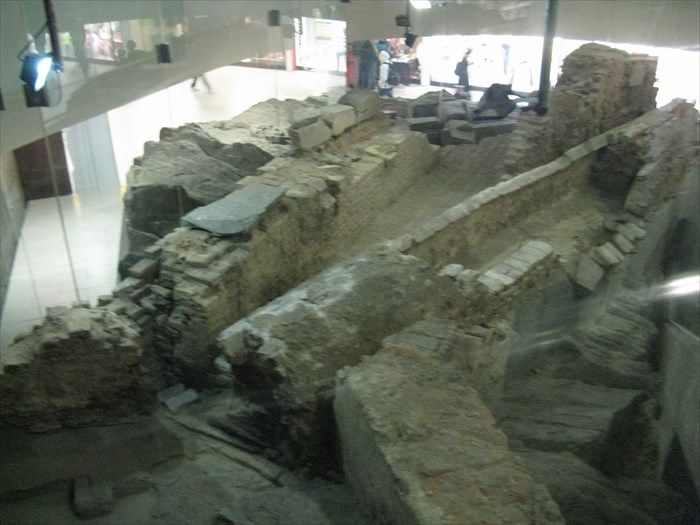
During the construction of “The Golden Acre” shopping Mall in 1975, ruins of Wagenaar’s reservoir and canals were unearthed. They have been declared as a national monument. Some of the ruins can be seen at the Golden Acre and are protected behind a glass window. The remainder of the structure lies buried beneath the surrounding development.
9 Adderley Street, Foreshore
See also Castle of Good Hope
Is this your business?Claim it now.
Make sure your information is up to date.Colourdots is an independent Western Cape regional information resource. Learn more about the site here.