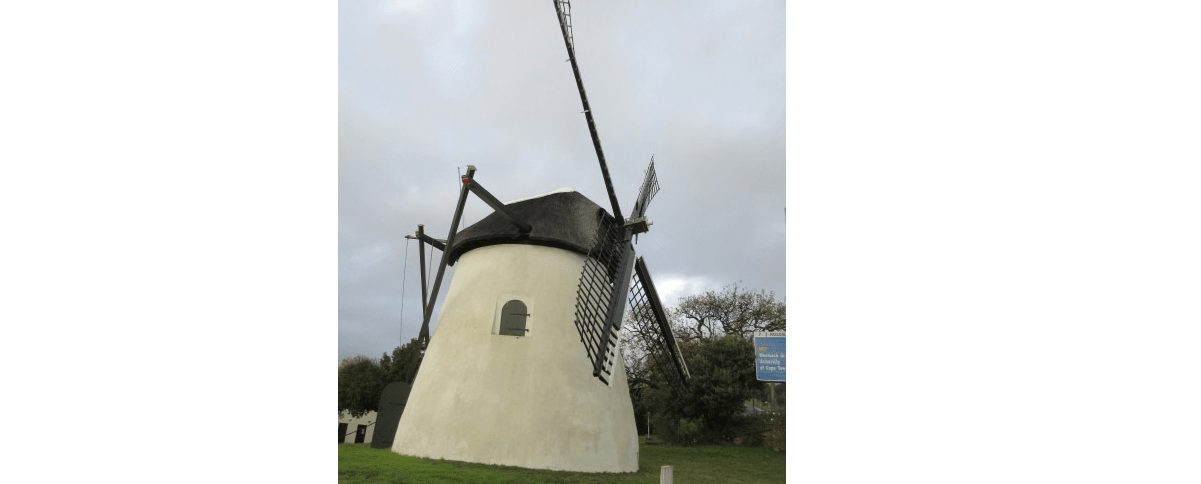
Mostert’s Mill
Mostert’s Mill was built around 1796 on the farm Welgelegen, owned by Gysbert van Renen. It was named after his son-in-law, Sybrand Mostert, following Van Renen’s death. The mill was the first privately owned mill in the Cape Colony. Before the British occupation of the Cape in 1795, only mills controlled by the Dutch East India Company were permitted.
By 1873, the mill had ceased operation but remained in the Mostert family until 1889, when it was sold to Mr Wilks, who in turn sold it to Cecil John Rhodes in 1891. Rhodes added it to his Groote Schuur estate, although farming on the property had ended after the phylloxera epidemic destroyed the vineyards.
The mill fell into disrepair but was restored in 1935 by the Public Works Department, employing Dutch millwright Christiaan Bremer. The restored mill was officially reopened on 1 February 1936 by Dr. Lorentz, the Minister Plenipotentiary to the Netherlands, in a ceremony attended by Prime Minister General Hertzog. Flour was ground for the guests at the event.
Mostert’s Mill is a three-story Cape-style truncated-cone tower mill, about 8 m tall and nearly 8 m in diameter. The first 2 m of the tower are built of stone, with the remainder made of unbaked brick. The walls are 1.5 m thick at ground level, giving an internal diameter of just over 5.5 m. The cap, threshing floor, and adjacent house were originally thatched, and the nearby house was likely the miller’s home.
After the 1930s restoration, the mill was operated occasionally but became derelict again during the Second World War. In 1986, its windshaft broke, causing the sails to crash to the ground. The Vernacular Architecture Society of South Africa then launched a campaign to save it, leading to the founding of the Friends of Mostert’s Mill in 1993. This group oversaw another full restoration in 1995, once again by the Dunning-Bremer firm, at a cost of R245,000.
On 18 April 2021, the mill was severely damaged in a fire that began on Table Mountain, destroying several buildings, including one of the University of Cape Town’s libraries and four thatched houses behind the mill. At the time, it was South Africa’s oldest working windmill.
By March 2023, the friends of the Mostert’s mill had nearly completed a full restoration, returning this historic landmark, after centuries of use, neglect, and renewal, to working condition once more.
Rhodes avenue Mowbray
read more here
Updated December 2025
Is this your business?Claim it now.
Make sure your information is up to date.Colourdots is an independent Western Cape regional information resource. Learn more about the site here.