Meiringspoort
Where did the name come from?
Meiringspoort takes its name from Petrus Johannes Meiring (1799–1876), who came from Worcester to the area in the 1820s. He was of German descent and a grandson of Pastor Arnoldus Meiring, who arrived in the Cape from Lingen, Germany, in 1743.,
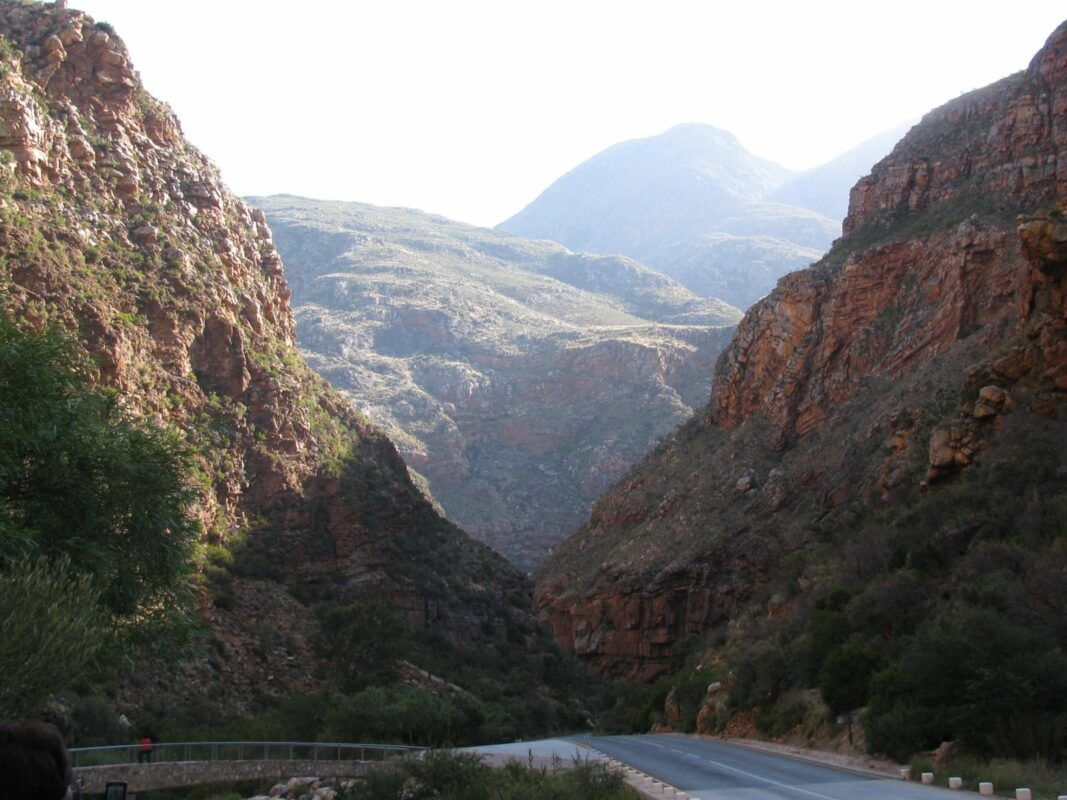
Meiringspoort is a 21 km gorge through the Swartberg Mountains, linking the Great Karoo with the Little Karoo. It lies on the N12 between De Rust and Prince Albert and is known for its towering sandstone cliffs, unusual rock formations and the Groot River, which runs through the poort.
People had travelled through the mountains long before the modern road was built. San people lived in the surrounding area, and an established bridle path through the poort was later used by settlers and farmers. By the 1850s, however, the route was becoming increasingly important to wool farmers in the Great Karoo, who needed a reliable way to transport their wool southwards to Mossel Bay harbour.
After years of petitions, work began on improving the route through the poort. The new road followed the Groot River and crossed it repeatedly, with some sections running directly through the riverbed. It was eventually completed by Adam de Smidt, the brother-in-law of road and bridge builder Thomas Bain, and officially opened on 3 March 1858. The opening was marked by a toast to Queen Victoria, with about 250 mounted men and 100 guests travelling through the poort. They were met by a convoy of wool wagons from the north, carrying what was described as the first freight of wool from the interior to reach Mossel Bay by this route.
The road was originally little more than a rough wagon road and was frequently damaged by floods. De Rust was established as a town only in 1899, more than 40 years after the opening of the poort road. The road through Meiringspoort was eventually tarred in 1971.
The modern road has also had to contend with the power of the Groot River. Severe floods in 1996 caused extensive damage, resulting in a major reconstruction costing about R70 million. The present route includes bridges and improved sections designed to withstand the conditions that had repeatedly damaged the old road.
The landscape seen today is the result of hundreds of millions of years of geological activity. The sandstone cliffs and unusual rock formations make the poort one of the most distinctive mountain passes in the Karoo, while the surrounding area supports a variety of plants and animals, including species with very restricted ranges.
Meiringspoort Waterfall
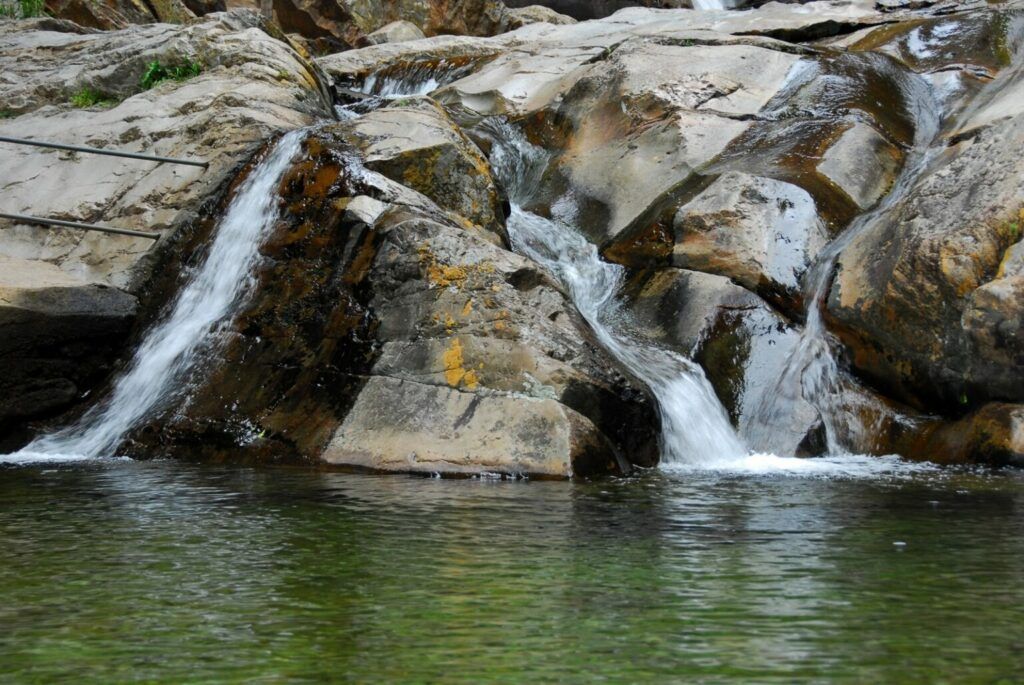
One of the best-known stops in the poort is the Meiringspoort Waterfall. The waterfall is hidden in a deep ravine and drops about 60 metres down a smooth rock face into a deep pool. Steps were cut into the rock in 1925, reportedly in preparation for the visit of the Prince of Wales during his South African tour that year.
The mermaid of Meiringspoort is named Eporia. She is said to be malevolent and responsible for wreaking havoc and the occasional flooding of the usually gentle Groot River. This happens once or twice in a decade and is assumed to be due to something having upset her.
There are several designated picnic areas along the route, while the main waterfall area has toilet facilities and an information centre. Visitors should use only the designated picnic and fire areas, bring their own wood or charcoal, take their rubbish with them and avoid feeding the baboons. Camping is not permitted. Walking on the mountain slopes can also be dangerous because of loose rocks and unstable ground.

Herrie se Klip is a well-known landmark in Meiringspoort associated with Afrikaans writer and attorney C.J. Langenhoven. In July 1929, Langenhoven carved the name “Herrie” into the rock, referring to the fictional elephant Herrie from his writing. He regarded Meiringspoort as a favourite place to relax and write, and his well-known description of the pass was: “In each bend you will find a drift and at each drift a bend.” Langenhoven also wrote the words to “Die Stem van Suid-Afrika”, part of which is incorporated into South Africa’s present national anthem. Herrie se Klip was later declared a National Monument and remains a protected cultural and literary landmark in the poort.
“Herrie” was a beloved, fictional, highly opinionated circus elephant featured as a protagonist in Langenhoven’s popular satirical-comedy books, Sonde met die Bure (1921) and Herrie op die ou Tremspoor (1925)