Kirstenbosch National Botanical Garden
Find directions to Kirstenbosch Gardens here
The name “Kirstenbosch” is believed to come from J.F. Kirsten, an 18th-century land manager linked to the property. “Bosch” is a Dutch word meaning forest or bush.
After British control of the Cape in 1811, the land was divided into grants. Colonel Christopher Bird built a residence, planted chestnut trees, and created a bath fed by a natural spring. The property was sold to the Ecksteen family in 1823 and later to the Cloete family, who developed it for agriculture, planting vineyards, orchards, and oak trees.
In 1895, the land was acquired by Cecil Rhodes. During this period, maintenance declined, the land became overgrown, and animals roamed freely. In 1898, Camphor Avenue was established. Rhodes bequeathed the property to the nation on his death in 1902.
The establishment of a national botanical garden is closely linked to Henry Harold Pearson, a Cambridge-trained botanist who arrived at the Cape in 1903. In 1911, Pearson, accompanied by Neville Pillans, identified Kirstenbosch as a suitable site. On 1 July 1913, the government formally set aside the land for a botanical garden with a limited budget.
Pearson accepted the role of director without a salary and began development under difficult conditions. The site required extensive clearing due to invasive growth, feral animals, and neglected orchards. Early work focused on an area known as “The Dell,” where cycads planted at the time remain. Additional funding was raised through the sale of firewood and acorns.
Pearson died in 1916 and was buried in the garden. His grave reads: “If ye seek his monument, look around.” Development continued under J.W. Mathews and later Professor R.H. Compton, who helped establish Kirstenbosch as a leading botanical garden.
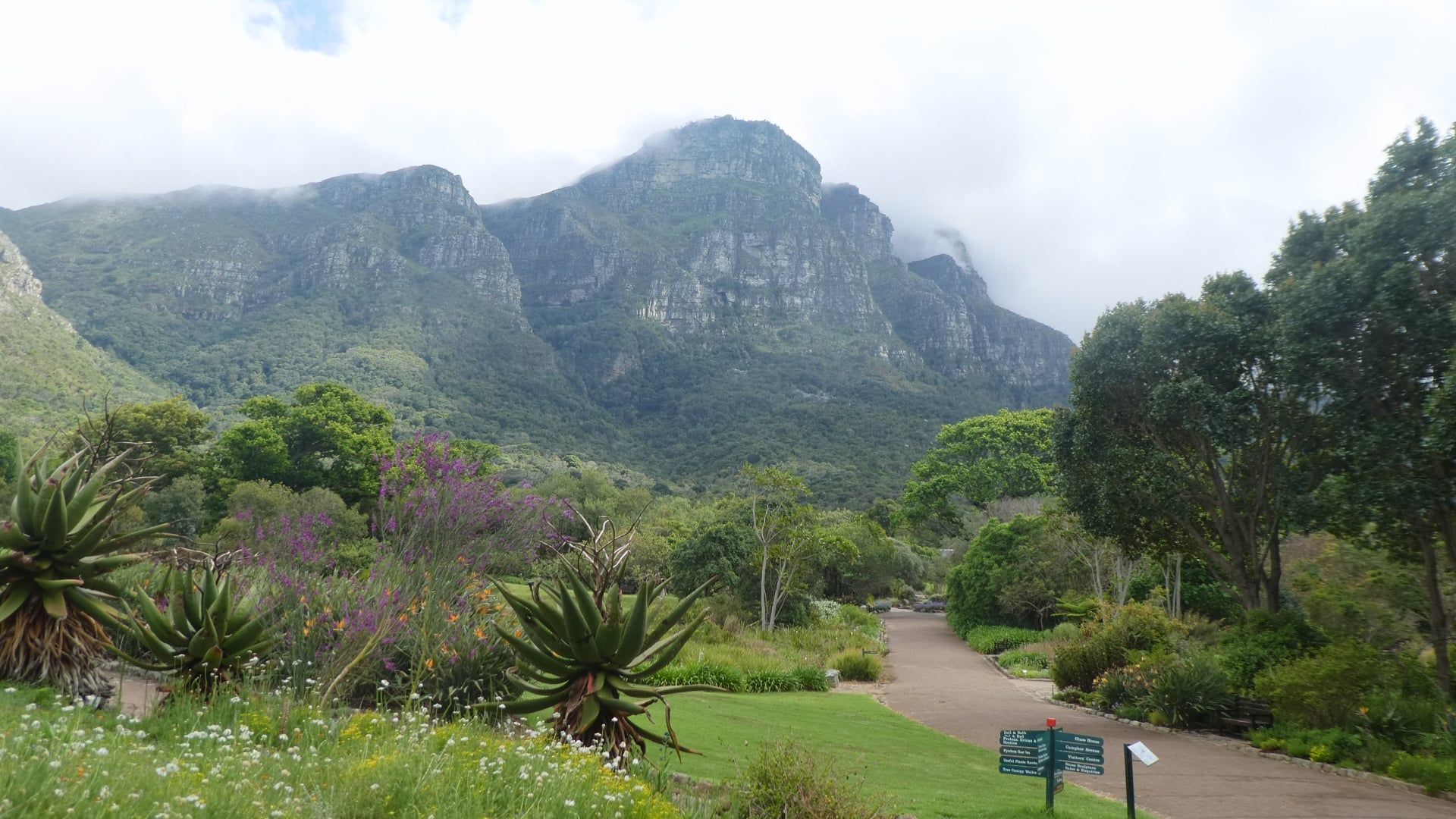
Kirstenbosch National Botanical Garden was founded in 1913 to conserve South Africa’s unique flora. It lies on the eastern slopes of Table Mountain and forms part of a network of national botanical gardens across the country.
The estate covers 528 hectares, including a 36-hectare cultivated garden and a larger nature reserve. It displays a wide range of southern African plants, including rare and endangered species, and is widely regarded as one of the great botanical gardens of the world.
- Look out for the summer concerts. Every Sunday evening in summer.
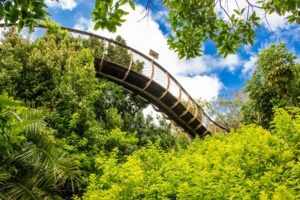
- The Centenary Tree canopy walkway is a curved 130-metre steel and timber bridge that winds through the treetops.
- Galileo open-air cinema on Wednesday nights from November to April. (screenings of well-known classic movies.)
- The sculpture garden is a permanent, though changing exhibition of African stone sculptures.
- Located on the lower slopes and above the stream, with its large, intertwining branches growing in all directions, lies a section of Van Riebeeck’s Hedge. This hedge is a series of indigenous wild almond trees that were planted in 1660 by the governor of the Cape to define a boundary between the Dutch and the Khoi-Khoi. The goal was to create a barrier that would prevent any livestock or people from getting through. An interesting point about Wild Almonds is that they contain cyanide and are poisonous unless specially treated by soaking and roasting, a technique discovered by the Khoisan people, who used to eat them.
- The singular cycad is one of the rarest and most highly prized plants in the world and can be found in the Cycad dell in the garden. The Cycad Amphitheatre, a natural amphitheatre above the Dell, displays this ancient plant group, which dates back to the time of the dinosaurs.
John Medley Wood discovered the plant in the Ngoye Forest in KwaZulu-Natal, where it was later identified as a new species and named after him in 1908. - The Harry Molteno Library/ Kirstenbosch Research Centre. The origins of the library are not documented, but the library has been part of Kirstenbosch National Botanical Garden since 1913, when the Garden was founded. The library was developed around the personal library of Professor Robert Harold Compton. 021 799 8712
- Colonel Bird’s Bath is a historic feature in The Dell; it was built around 1811 by Colonel Christopher Bird, the Deputy Colonial Secretary. This bird-shaped pool was designed to collect and clarify spring water before being piped to his house. The bath was constructed with Batavian-type bricks and fed by four ice-cold, crystal-clear springs. The surrounding paths and bath area have been paved with local stone by Kirstenbosch stonemasons.
What else to see in the Garden
The Botanical Society Conservatory displays succulents from southern Africa, from tiny stone plants to the mighty baobab, the largest succulent in the world. It also features bulbs, ferns and Welwitschia. The Fynbos Walk is a path that leads from the Rycroft Gate through the upper part of the Garden, planted with fynbos, a vegetation type unique to the Cape Floral Kingdom. The Protea Garden Proteas and serrurias flower here in winter and spring, and pincushions flower in summer. The Camphor Avenue. In 1898, Rhodes planted this historic avenue of trees consisting of camphor trees, Cinnamonum camphorum, and Moreton Bay figs, Ficus macrophylla. The Mathews Rockery, named after the first curator, displays succulents and bulbs from the dry parts of South Africa. Useful Plants: indigenous plants that are used in traditional medicine, for dye, tea, mat and basket making and other uses. The Forest Braille Trail is a short, self-guided trail that passes through natural forest and over a patch of wetland. The Fragrance Garden has plants with unusual textures and scents. The Garden of Extinction displays about 1500 South African plants that may soon be extinct in the wild. Pearson’s Grave is on the slope above the Dell. His epitaph reads: ‘If ye seek his monument, look around. Annual spring flowers like Namaqualand daisies are best viewed at midday. The Koppie only has tough, drought-resistant plants which survive on this well-drained sandstone outcrop. The Erica Garden has over 600 species on display. The Restio Garden displays the Cape Reed family. The Waterwise Garden save water in our own gardens by using the right plants. The Fynbos Garden features a variety of plants of this vegetation type. The Garden of Weeds presents South African plants that have become weeds in other parts of the world, with information on how to stop their spread. The Vlei Garden is next to the Botanical Society Office.
Kirstenbosch Botanical Gardens are home to hundreds of bird species. For full identification and seasonal details, see this comprehensive Western Cape bird guide.
- Kirstenbosch National Botanical Garden is free to all pensioners on Tuesdays, except on public holidays
- Free Guided Tours of the Garden, approximately 90 minutes long they leave from the Information Desk, Visitors’ Centre (Gate 1) at 10 am Mondays to Saturdays. Tours are limited to 15 people, and places are allocated on a first-come, first-served basis.
- Rhodes Drive, Newlands. kirstenboschinfo@sanbi.org.za
Kirstenbosch National Botanical Garden, Garden Centre
Here is a South African indigenous nursery that sells a wide range of indigenous plants and products made in South Africa. phone: 021 797 1305 info@kgcentre.co.za
Dog policy at Kirstenbosch.
Dogs are not allowed in the developed Garden or the natural area immediately surrounding the Garden as far as the upper contour path. Dogs may be brought in via Rycroft Gate (Gate 3), where they may be walked up to the 300 m contour path via the path through the Seed Orchard/Stock Beds.
Hikes in Kirstenbosch
BRAILLE TRAIL
This easy 15-minute route, which starts and ends at the Fragrance Garden, is suitable for unsighted people to walk unassisted, and the plants are labelled with Braille signs. It’s a short circular route through a natural forest and a patch of wetland.
BOEKENHOUT TRAIL
This fairly easy 30-minute trail of about one kilometre starts at the Old Dam; the wow factor of this hike is the unusual views of the mountain. It can be steep in some places.
STINKWOOD TRAIL
Prized for its wood, the stinkwood population has been severely decimated, so although there aren’t many mature stinkwoods, it’s an area of rehabilitation for the species. Still a pleasant forest walk, look out for pioneer forest trees such as keurboom, bladdernut and wild peach. This hike is easy and takes about an hour
YELLOWWOOD TRAIL
For this reasonably easy hike, start at the Fragrance Garden and follow Skeleton Stream to Skeleton Waterfall, cross Nursery Stream twice, and you’ll end up where you started. The trail is about 3km long and should take about two hours, depending on your fitness level.
SILVERTREE TRAIL
Start this trail at Gate 3 and enjoy the beauty of Kirstenbosch. This moderately easy hike takes between three and four hours and crosses the estate via the 300-metre contour path. The views are stunning.
SMUTS TRACK UP SKELETON GORGE
This difficult six-hour hike is for the adventurous. Set off at the Fragrance Garden, and follow Skeleton Stream up Table Mountain. The climb up the gorge is steep and can be dangerous, especially during wet weather. Your ascent is aided by ropes and ladders. (It’s recommended you bring a map of Table Mountain along with you)
.NURSERY RAVINE
This difficult hike involves a very steep climb heading straight up Table Mountain. Hundreds of steps will lead you through forests and more rocky areas. It takes about four hours, but the cherry on top is that you get to paddle in the Hely Hutchinson Dam.
How much time will I need for a visit to Kirstenbosch?
Most visitors spend 2–3 hours at Kirstenbosch National Botanical Garden, but it really depends on how deeply you want to explore. 1.5–2 hours for a relaxed walk through the main gardens, the lawns, and popular spots. 2–3 hours will give you time for the canopy “Boomslang” walkway, the fragrance garden, the cycads, and some trails. 3–4 hours if you enjoy plants, photography, or walking some of the longer paths up toward the mountain slopes. Half-day — If you want to combine the gardens with one of the hiking routes that start from Kirstenbosch (Skeleton Gorge or Nursery Ravine).
You may be interested in Victoria and Alfred Waterfront or Table Mountain Cableway
Updated November 2025