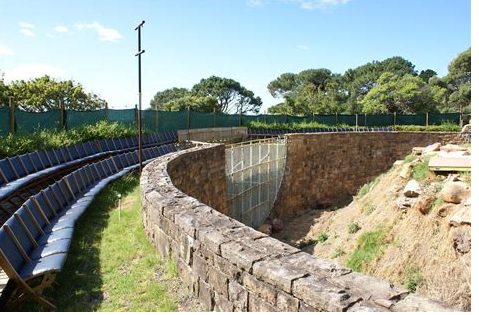
Groot Schuur zoo
Groot Schuur Zoo was a project conceived by Cecil John Rhodes, who was Prime Minister of the Cape Colony from 1890 to 1896. He bought a 2-hectare piece of land on the slopes of Devil’s Peak in 1893. At the time, there was an abundance of wildebeest, leopard and wildcats, deer, duiker, eland, ostriches and zebra. In 1896, Rhodes received two lions and a leopard as gifts. Enclosures were built to house these animals,
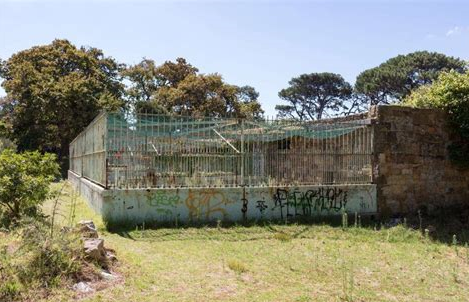
He planned to build a Paestum temple of colonnades to house the lions, where people could admire their natural strength. However, this was not built, and a cage-like structure was built instead.
The idea was for all to have free access to the area for an affordable family outing. Entrance to the Groot Schuur zoo was free, and it was a very popular attraction in Cape Town. There were huge aviaries with birds in many shapes, sizes and colours. Screaming peacocks strutted everywhere, fanning their tail feathers and showing off. Penguins were fenced in a very large aviary with a long pond. It is said there was even an elephant and a camel living here.
When Rhodes died in 1902, he left the estate to the government. The Lion House stood until 1930, when it was demolished to make way for new enclosures. Wire-fenced cages and large aviaries were built to house his private menagerie. In 1931, the site formally opened as Groote Schuur Zoo. But by the 1970s, rising operational costs and changing expectations around animal welfare created sustained pressure on the facility. The Apartheid government, facing tightening finances, reduced support.
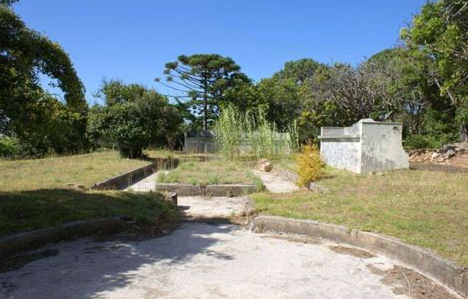
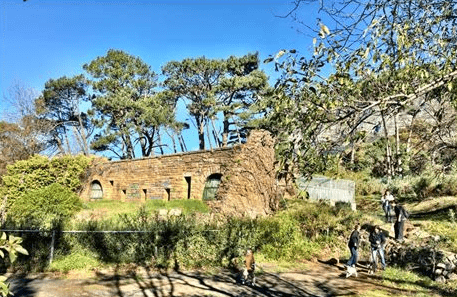
The zoo fell into decline, and it closed sometime between 1975 and 1985. The now derelict Groote Schuur Zoo is a popular attraction in Cape Town with its abundance of shady oak and pine trees, with masses of beautiful hydrangeas.
There is a story that there was a kudu bull that repeatedly got into and damaged the garden at Rudyard Kipling’s home (known as The Woolsack, which is a National Monument at UCT)
The abandoned buildings of the zoo stand there still, covered in vegetation. At one point during the time the zoo was in operation, two tahirs, a breed of Himalayan mountain goat, escaped up Table Mountain. These goats bred, and quite a large population grew that lived on the mountain. In 2000, it was decided to cull them due to the environmental damage they caused. However, while they are rare, there is still a small population of goats on the mountain. The zoo also played a role in the spread of the European starling in South Africa.