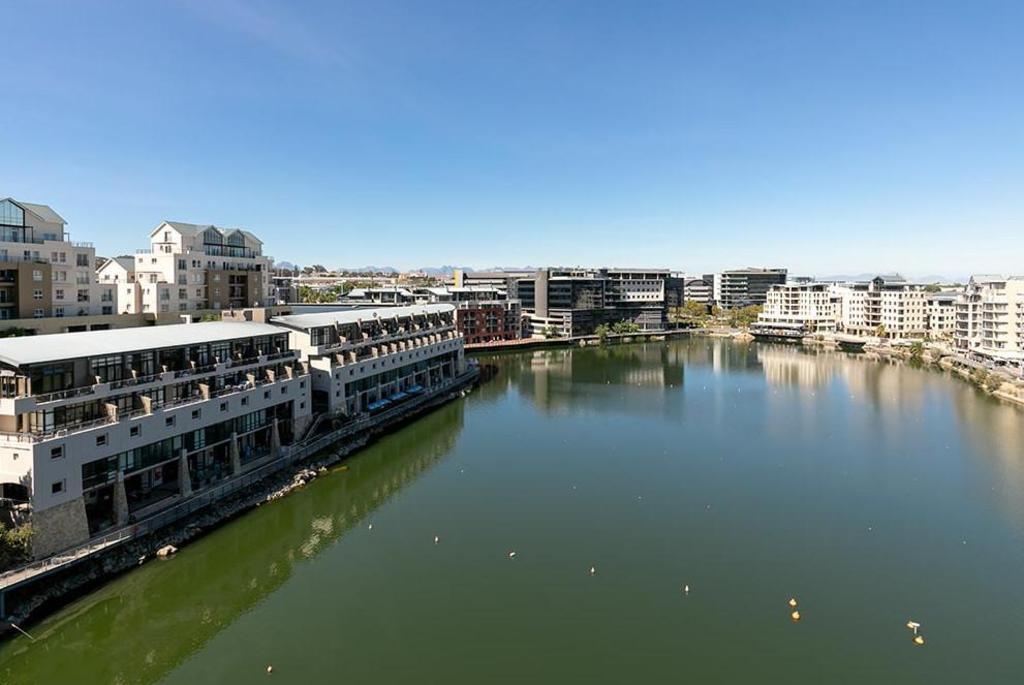
Tyger Waterfront
The Tyger Waterfront was not always a residential and commercial precinct. For much of the early 20th century, the area was industrial land used for quarrying and brickmaking.
During the 1930s, two large clay-digging operations were active in what later became the Tygervalley area: the Hume grounds and land owned by Brick and Clay. At the time, the landscape looked very different. The ground north of today’s N1 freeway was open industrial terrain. Places that now include Tygervalley Shopping Centre, Willowbridge, the Bellville Velodrome, Bellville Athletics Stadium and the Tyger Waterfront did not yet exist.
West of the Elsieskraal River, stone was quarried, and concrete products were manufactured. East of the river, workers excavated clay to make bricks. The clay was moved through underground tunnels to kilns, marked above ground by tall brick towers. Excavation continued for decades and by the 1960s the main quarry was more than 100 metres deep.
As the clay reserves were depleted during the late 1960s and early 1970s, the Hume Pipe Company ceased operations. Ownership later passed to Barlow Rand, leaving roughly 260 hectares of disturbed land in the middle of a growing residential area. The abandoned quarries, filled with water, became hazardous, while dense bush and isolation raised safety concerns.
The company also owned nearby industrial land and attempted to subdivide and redevelop it. Town planners were eventually brought in, and redevelopment proposals were approved. At the same time, Bellville’s traditional town centre was losing businesses to surrounding areas, and a regional shopping centre on the old quarry land offered both commercial revival and funding for rehabilitation of the damaged ground.
In the early 1980s, the municipality purchased the land, and development began. Tygervalley Shopping Centre was constructed during a difficult economic period, but was considered modern for its time. Parts of the quarry were stabilised, and the Velodrome and athletics track were built. Further development between the sports facilities and the shopping centre followed gradually.
Separate plans were once considered for a Stellenbosch University satellite campus, but these never materialised. Over time, private developers transformed the rehabilitated quarry into a mixed-use precinct of apartments, offices and restaurants around artificial waterways. This became the Tyger Waterfront.
The Brick and Clay land east of Durban Road, near O’Kennedyville and High Street, also required rehabilitation. Old pits were filled and landscaped, and a park area was created between commercial developments and nearby homes. These improvements contributed to the growth of Durban Road into what became known locally as Bellville’s “Golden Mile”.
Today, the Tyger Waterfront covers about 23 hectares between the Tyger Falls and South Gate precincts. It is a residential and commercial area within the Tygervalley region on the northern edge of Cape Town. The area offers restaurants, walking routes around the canals, and water activities such as canoeing and paddle-boarding. It sits close to Tygervalley Shopping Centre, Willowbridge Lifestyle Centre and other attractions in the surrounding suburbs.
What was once a landscape of kilns, tunnels and deep quarries has been reshaped into one of Bellville’s most recognisable modern developments — a reminder of how much of Cape Town’s suburban growth stands on former industrial ground.
Is this your business?Claim it now.
Make sure your information is up to date.Colourdots is an independent Western Cape regional information resource. Learn more about the site here.